Category: Speciality Sprayers

Main category for all sprayers that are not horizontal booms

  • Do Labels Help us Apply Pesticides Properly?

    Do Labels Help us Apply Pesticides Properly?

    It happened three times this spring.  As is often the case, I was contacted by growers who wanted help with herbicide application.  In most of these calls, the discussion revolves around the proper choice of nozzles for a specific task, perhaps some questions on spray pressure, water volume and travel speed.

    But these three were different.  Instead of being seasoned applicators, all three were new to the business.  And more importantly, they had done their homework by looking at product labels before calling.

    Labels give us important information on product rates, crop and weed staging, mixing order, sprayer cleaning, and personal and environmental protection.  They’re very valuable there.  But they also provide application information, and that’s where the problems begin.

    Perseverance Required

    I have to commend my three clients:  they showed great tenacity by actually finding application information on a pesticide label in the first place.  This document is so mired in legalese protectionist language at the front that it discourages all but the most persistent.

    And often, the application information comes in several parts, interspersed among other information.  Mixing instructions.  A little later, application. Somewhere nearby, buffer zones.  Another paragraph for cleaning.  Rainfastness?  Keep looking.

    It forces the reader to skim through the document, hunting for relevant information.

    But once my clients found application instructions, they obviously questioned if they should believe it, or else they wouldn’t have called.  The application statements on many labels, simply put, are from long ago, and it’s obvious.

    Consider the following two label excerpts, the first from a product initially registered in the mid 1980s and still available, the second from one registered about 30 years later:

    1980s:

    Application should be made using a minimum of 55-110 litres of water per hectare, at a pressure of 275 kPa, or 310 kPa if using check valves, and at a ground speed of 6-8 kph.

    The use of 80° or 110° flat fan nozzles is recommended for optimum spray coverage.

    Do not use flood jet nozzles, controlled droplet application equipment or Sprafoil® equipment.

    Application of the spray at a 45° angle forward and higher water volumes will result in better spray coverage and penetration of the crop canopy.

    Uniform, thorough coverage is important to obtain consistent weed control. Higher water volumes should be used under dense crop and weed canopies to ensure thorough coverage of the target weeds.

    2010s:

    Apply in a spray volume of 46.8 – 93.5 L/ha unless otherwise specified in tankmix partner section of this label – at 207-345 kPa (30-50 PSI) pressure to ensure proper weed coverage.

    Flat fan nozzles of 80° or 110° are recommended for optimum coverage.

    Do not use floodjet or controlled droplet application equipment or Sprafoil® equipment.

    Nozzles may be oriented 45° forward to enhance crop penetration and to give better weed coverage.

    Uniform, thorough coverage is important to obtain consistent weed control. Higher water volumes should be used under dense crop and weed canopies to ensure thorough coverage of the target weeds.

    Thirty years apart, but remarkably similar.

    Crop protection companies spend about 10 yrs. and $250 million to produce a new pesticide and register it for use.  Having made this commitment, it would be most useful to see a small further investment to provide current application information that is relevant to applicators.

    After all, these applicators purchase the active ingredient to provide a return on this multi-million dollar investment, to the tune of about 2 billion dollars per year in Canada alone. They deserve good application information.

    Imagine this scene:

    “Doctor, thank you for this new high tech pharmaceutical engineered to help me with my serious illness.  How should I take it?”

    “Not sure.  Here, read this cough syrup label I found in my drawer.  Should be pretty close.”

    It’s clearly ridiculous

    Let’s dissect these labels to see how they could be improved.

    Flat fan nozzles of 80° or 110° are recommended for optimum coverage…

    Our sample labels refer to what we assume are conventional flat fan nozzles.  While popular in the 80s, these have all but disappeared from sprayers over the course of the past 20 years or so.  We haven’t recommended them since then because they drift too much. They’ve been replaced by low-drift nozzles, either pre-orifice, or air-induction.

    Nozzle fan angles are now generally 110 degrees or more, and frankly, the difference between 80 and 110 degrees is not that important.  What’s important is proper overlap, achievable with a visual assessment followed by boom height and pressure adjustments.  Unfortunately the label is silent on that.

    Application should be made … at a pressure of 275 kPa, or 310 kPa if using check valves…

    A nozzle’s recommended operating pressure depends on the specific nozzle model and on the spray quality (average droplet size) required. With literally many dozens of nozzles now available to each applicator, general pressure suggestions are likely to be wrong, and are more of a liability than a help. And they force label non-compliance when over-ruled by a nozzle manufacturer’s recommendations.

    Speaking of spray quality, growers crave to know at what spray quality a product should be applied for best performance and lowest drift. Some labels refer to spray quality (e.g. “apply with a Coarse spray”), but this is with reference to spray drift and buffer zone distances, not efficacy, and that distinction is not made.  Knowing the right quality for efficacy would help applicators choose the right nozzle and pressure to meet that criteria.

    Higher pressures if using check valves?  Nobody has brass screens with check valves anymore.  Sprayers have had modern diaphragm check valves for a generation, and those don’t produce pressure losses.

    And we all know that six to eight km/h is hardly a common speed these days.

    Do not use floodjet or controlled droplet application equipment or Sprafoil® equipment

    Sprafoil nozzles have not been produced in Canada for about 25 years, in fact their manufacturer is no longer in business.  Controlled droplet atomizers, while becoming more popular again on aircraft, were last seen on ground sprayers in the 1980s. Even then, total installed numbers were probably in the single digits.

    As for FloodJet nozzles, those went out of style for herbicides in the late 70s, and were replaced by the very successful TurboTeeJet nozzles shortly after.

    Nozzles may be oriented 45° forward…

    Nozzles are rarely tilted 45 degrees forward for herbicide application anymore.  Maybe that’s because spray booms aren’t built that way today, or because modern booms on self-propelled sprayers are now about 30” (75 cm) above ground, and we travel at about 15 mph (22 km/h).  So the forward tilting, though shown to be effective for grassy weeds at 5 mph (8 km/h) and 20” (50 cm) boom heights, as researched in the 1970s, isn’t relevant for herbicides with higher booms.

    Uniform, thorough coverage is important to obtain consistent weed control.

    Statements advocating for good coverage are nice, but they aren’t useful.  Everybody knows we want good coverage.  What applicators need to know is how they should measure coverage, and what good coverage actually is.  Can we use water-sensitive paper?  How much of the target should be covered?  How many droplets should be in each square centimetre?  How can we measure that in the field, right now? How does it depend on the crop canopy, on weed stage, and on spray quality? The more information an applicator gets, the higher the chance of success.

    Apply in a spray volume of 46.8 – 93.5 L/ha…

    The only statement that survives our little examination is about water volume. Water volume is important.  But even there we have a problem.  The volume is in L/ha.  This is useful in some parts of Canada, but not in the west, where producers communicate primarily in US gallons per acre.  And in the west, provincial guidelines have generated this odd hybrid of L/acre, which few people use for spray volume.  But 46.8 to 93.5 L/ha?  How is that level of precision justified? (I know that this is a conversion from 5 and 10 US gpa…so why not just say so?)

    A Solution

    The problem with having outdated or impractical information on labels is that it creates disrespect.  Since labels are documents enforceable by federal law, applicators want to comply. At this time, they can’t, and probably shouldn’t, if they want to do the job right.

    A vision for a good label should be one that respects the needs of the applicator.  Such a label:

    • places the information that applicators need at the top;
    • is updated regularly to reflect modern practice and useful advice;
    • helps a new applicator work out how to apply the product with any equipment;
    • identifies a spray quality that offers good coverage and low drift;
    • makes reference to research that supports variations in the application guidelines;
    • is available electronically, readable on a mobile device, i.e., not pdf.

    This label would protect the environment and bystanders, and would foster better pesticide performance.

    This label is easy to generate.

    This label would be read by applicators.

    What’s it going to take?

    Additional:

    This article created a great deal of discussion. We decided that if we were going to point out issues with the current labelling system, we should also propose a way forward. Read about our Label Summary Sheet proposal.
  • Evaluating Electrostatic Spraying in Carrot

    Evaluating Electrostatic Spraying in Carrot

    This research was performed with Dennis Van Dyk, OMAFA Vegetable Crop Specialist.

    In 2018, MS Gregson introduced a line of electrostatic sprayers (the Ecostatik) in Canada. While electrostatic technology has been used in agriculture since the 1980’s, this is the first time ground rigs have been so readily available to Ontario (possibly Canadian) growers.

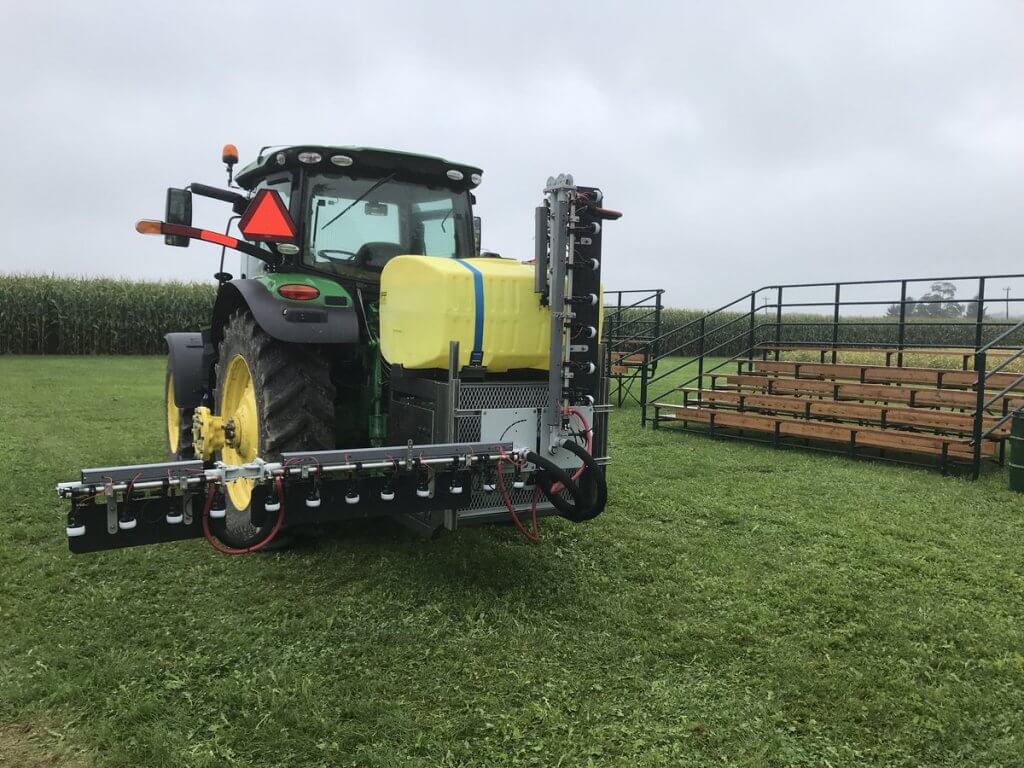
    The 3-point hitch Ecostatik can be configured for vertical booms or for banded/broadcast applications. The largest version has a 150 gallon tank, 10 gallon rinse tank and 72 nozzles on 7.5″ centres on a 60 foot boom. That model requires a 75 HP tractor, but 100 HP is preferred. The manufacturer claims the Ecostatik uses 50% less spray mix, gives superior underleaf coverage, and loses less spray to the soil compared to conventional methods.

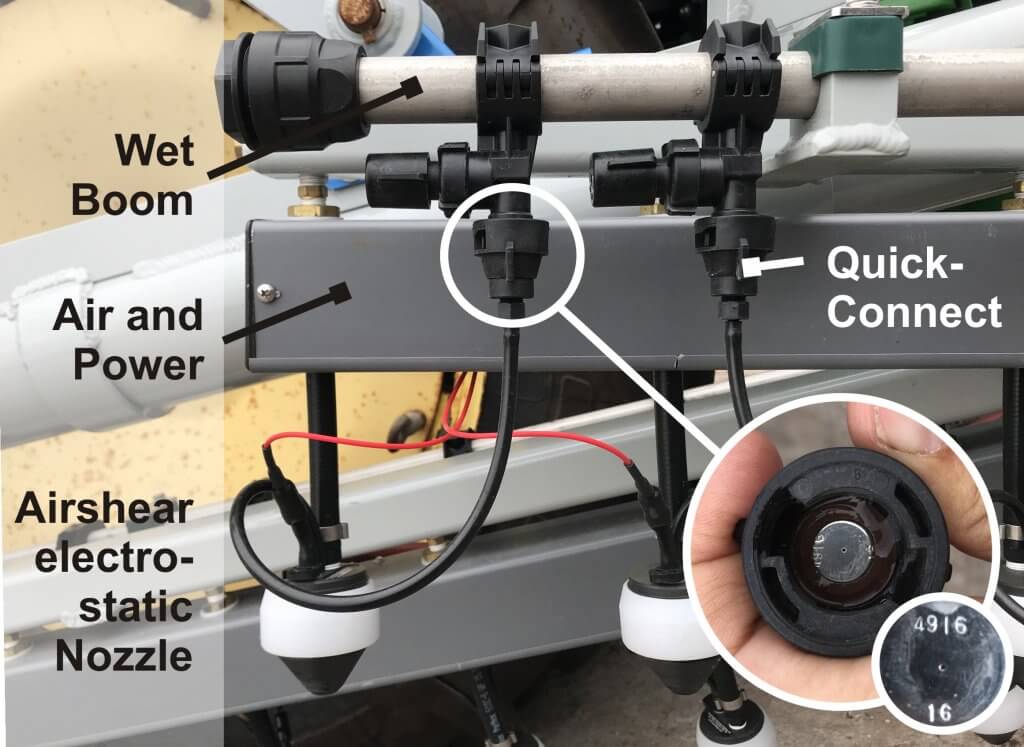
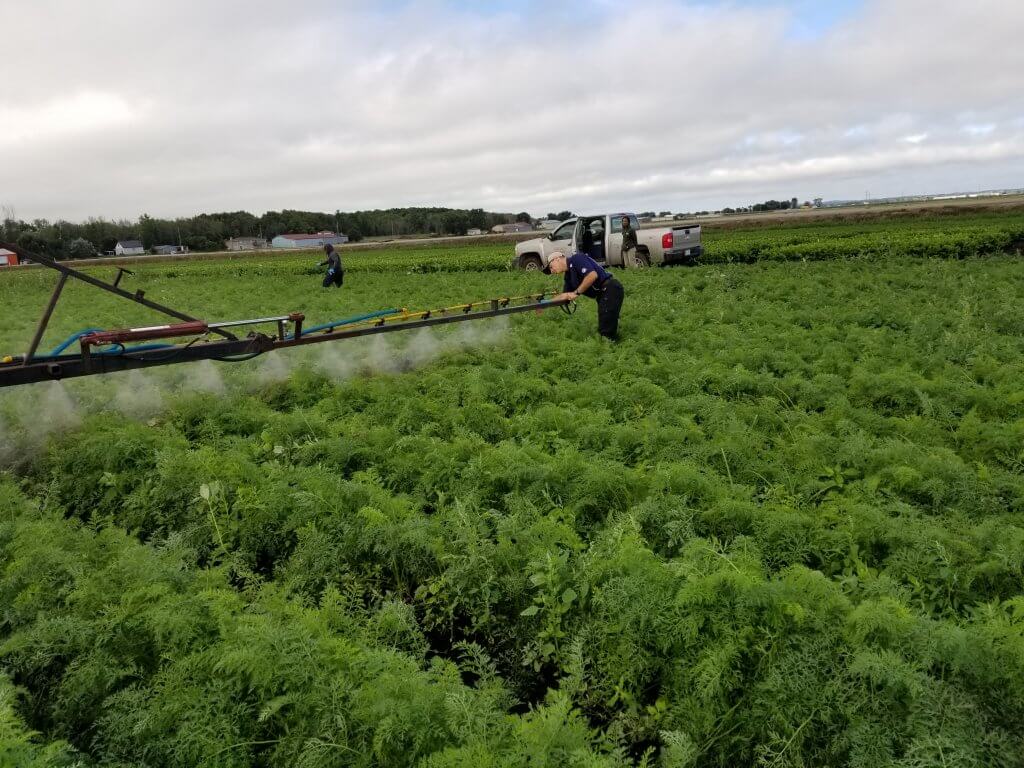
    Ecostatik 3-point hitch electrostatic sprayer. 14′ boom model pictured.

    Objective

    In the summer of 2018 we evaluated and compared the electrostatic sprayer to conventional application methods at the University of Guelph’s Holland Marsh Research Station. Our goal was to assess spray coverage and physical drift in a vegetable crop.

    Treatments

    • Treatment 1: Conventional Hollow Cone (HC) at 53.5 gpa (500 L/ha).
    • Treatment 2: Conventional Air Induction (AI) flat fan tip at 50 gpa (468 L/ha).
    • Treatment 3: Ecostatik at 11.8 gpa (110 L/ha): electric charge on.
    • Treatment 4: Ecostatik at 11.8 gpa (110 L/ha): electric charge off.

    Sprayer set-ups

    Conventional Sprayer

    • 11.5 ft (3.5 m) boom with 20” (50 cm) nozzle spacing set 18” (45 cm) from nozzle to top of crop.
    • Treatment 1: D3-DC25 HC @ 140 psi and 3 km/h. SC-1 SpotOn calibration vessel (SC-1) gave an average flow of 1.36 L/min (0.36 gpm). Very Fine spray quality.
    • Treatment 2: AI11003 AI @ 80 psi and 4 km/h. At 50 psi, SC-1 gave an average flow of 1.21 L/min (0.32 gpm). Very Coarse spray quality.

    Ecostatik Sprayer

    • 15 ft (~4.5 m) boom with 7.5” (19 cm) nozzle spacing set 18” (45 cm) from nozzle to top of crop.
    • With tractor set to 2,100 rpms, avg. air speed was measured using a Kestrel wind meter. The turbulent nature of the air precluded testing with a Pitot meter. At 5″ from the nozzle: 71.5 mph (32 m/s). At 10″: 37.5 mph (16.6 m/s). At 18″ (target distance): 21 mph (9.4 m/s).
    • The MaxCharge nozzles contained TeeJet CP4916-16 flow regulator orifice plates. At 25 psi they should have emitted 0.020 gpm. However, the SC-1 indicated a consistent 0.034 gpm from multiple nozzles. We postulate that the air assist created a low pressure environment that increased flow. Extremely Fine spray quality.
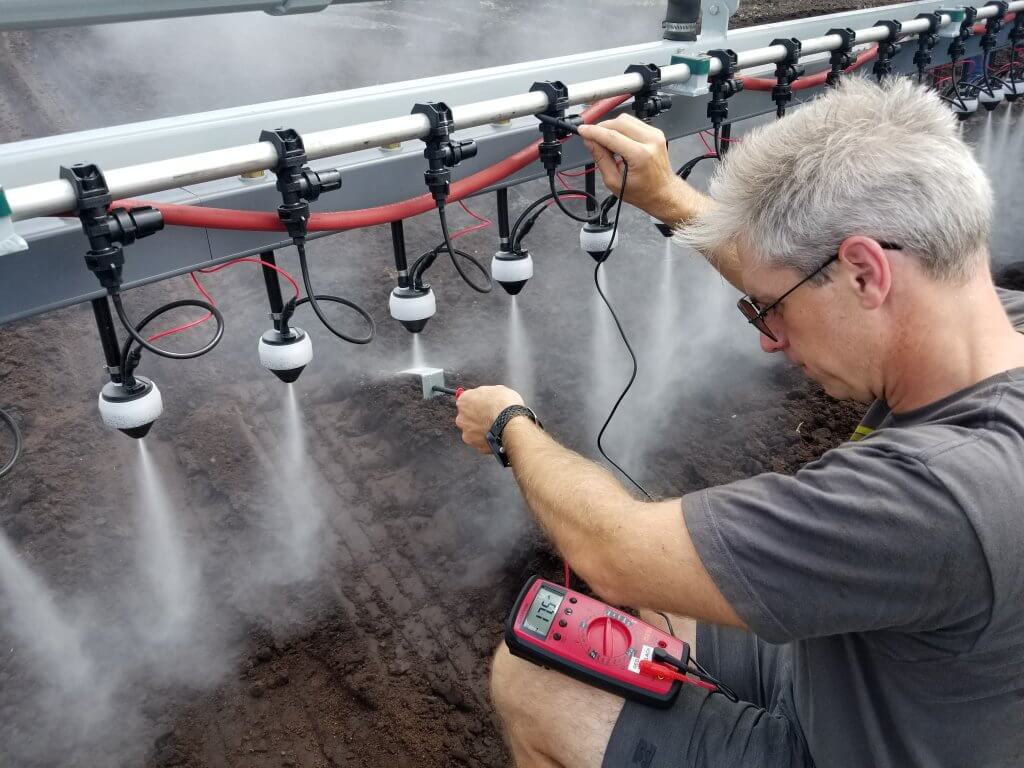
    • Treatment 3: Electric charge of -16 µA (tested using a voltmeter set to 200 µA) and speed of 3.7 km/h.
    • Treatment 4: Electric charge off and speed of 3.7 km/h.
    The Ecostatik boom
    Testing electrostatic charge with a voltmeter. Hair standing on end was a fun extra.

    Experimental Design

    Fluorimetry

    We used the fluorescent dye Rhodamine WT as a coverage indicator. This allowed us to take tissue samples to evaluate deposition, rather than rely on analogs like water sensitive paper. Further, the dye is detectable in parts per billion concentrations, making it sensitive enough for detection in drift studies.

    • The conventional sprayer received 40 gallons (151.5L) of water dosed with 303.5 mL dye (i.e. 2 mL / L).
    • The electrostatic sprayer 20 gallons (75.75 L) of water dosed with 151.5 mL dye (i.e. 2 mL / L).
    • A sample of the tank mix was collected from the nozzle prior to each application. It was later used to calibrate the fluorimeter for samples taken during that application.
    • Tissue samples were removed and dried to establish their dry weight.
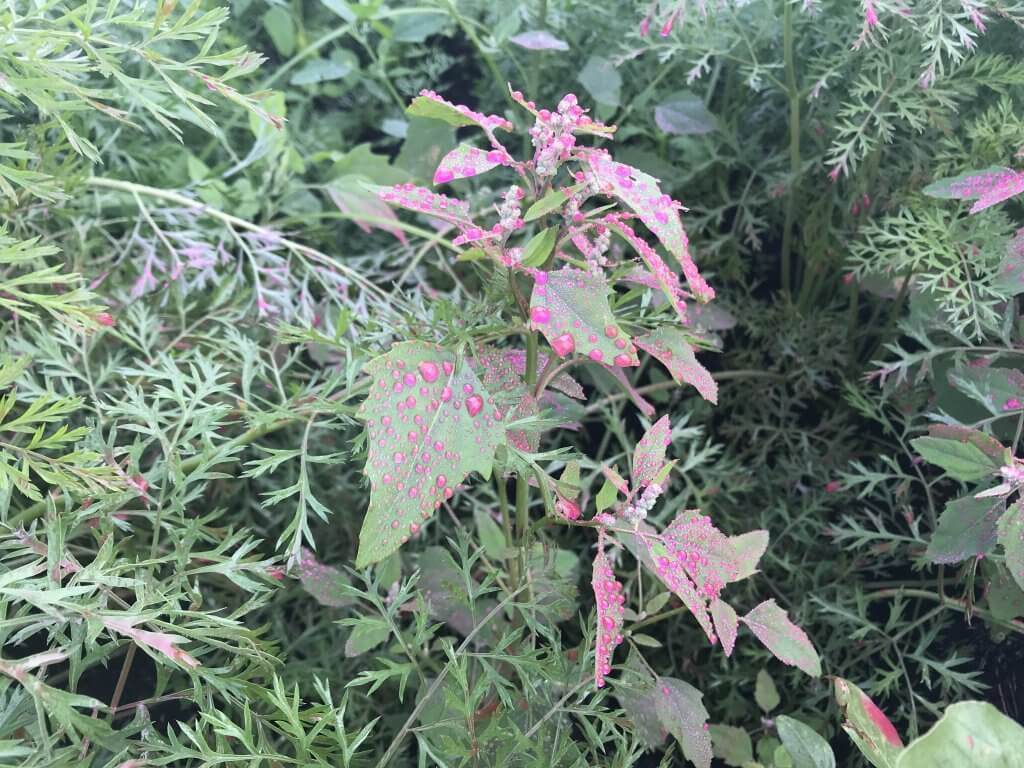
    Rhodamine WT pooling on carrot (and weeds) as boom charged prior to application.

    Spray Coverage

    We chose to spray carrot on 20″ (50 cm) spacing on August 30, when the crop canopy was densest and represented the most challenging target. Our targets were leaflets located about mid canopy depth, and 1″ lengths of stem just above the crown. A diagram illustrating the experimental design appears later in the article.

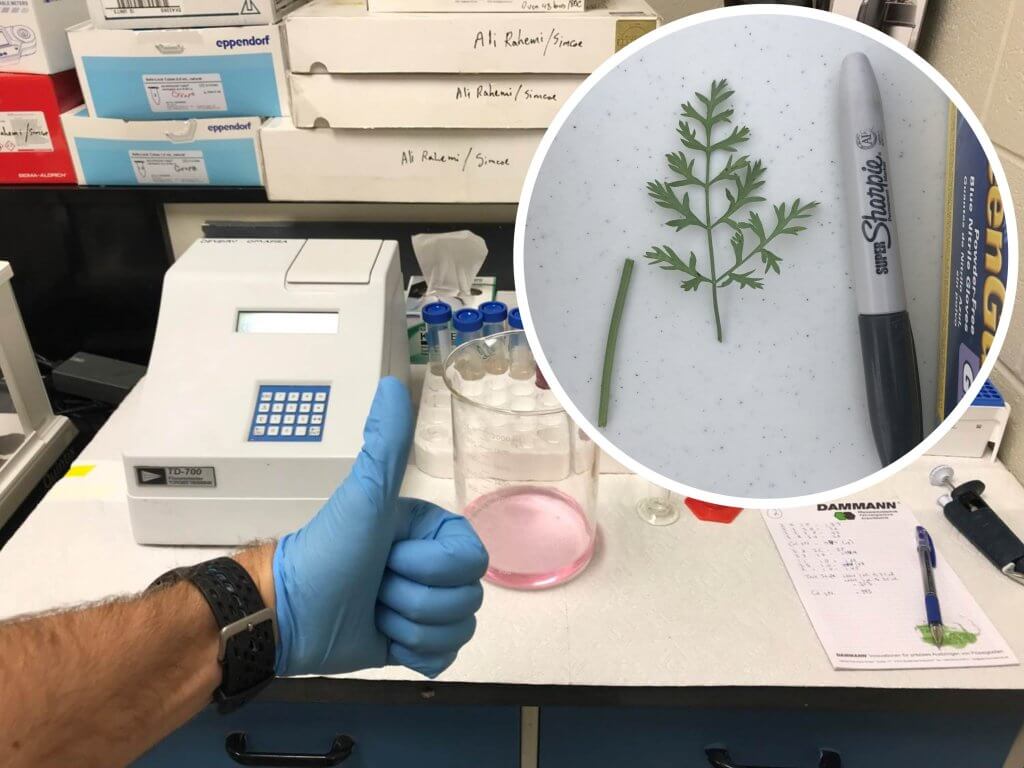
    Fluorimetry lab station. Inset: A typical length of stem and a leaflet with a Sharpie for scale.
    Drawing a tank sample prior to application. Carrot canopy was mature and very dense.
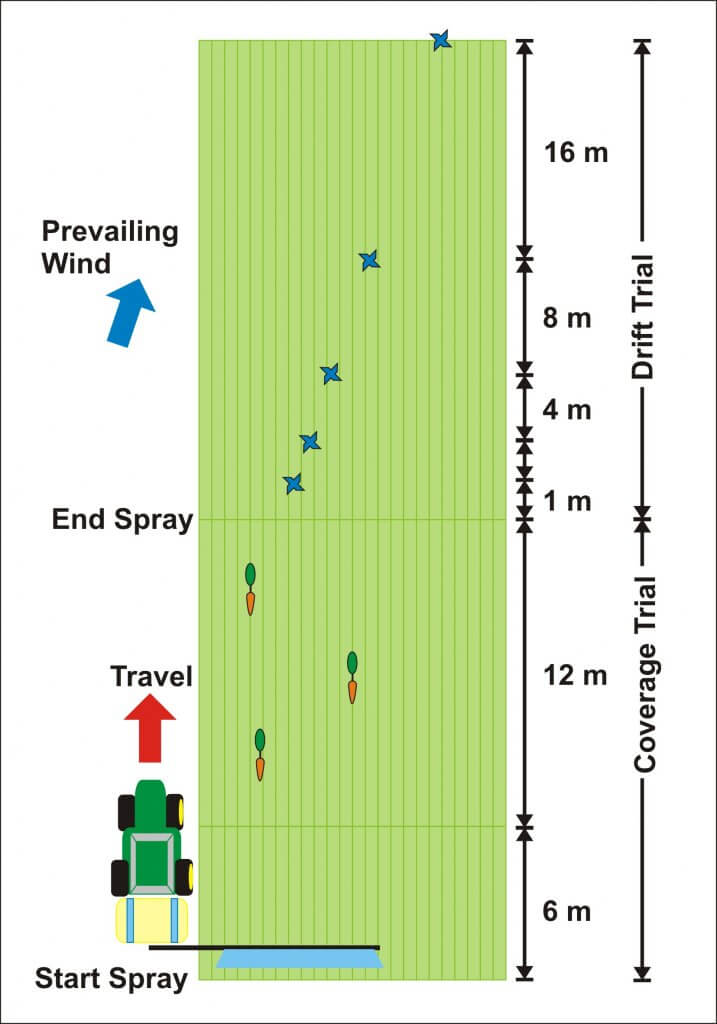
    • 12 m blocks were randomly flagged for each treatment. There were 3 blocks per treatment. 4 treatments * 3 replications = 12 blocks.
    • Temperature, windspeed, humidity and time were recorded prior to each application.
    • Three plants were randomly sampled from each block. These sub samples were averaged to get a single data point. 3 replicated blocks x 4 treatments x 6 subsamples = 72 tissue samples (36 leaflets and 36 stems).
    • Samples were collected 60 seconds after spraying ended, placed in sample tubes pre-filled with 40 mL of water and immediately placed in the dark.

    Drift

    We also performed an analysis of physical drift for each treatment.

    • 4″ lengths of pipecleaner mounted vertically ~12″ above the crop canopy as drift collectors.
    • They were placed in a straight line from the middle of the boom at 1 m, 2 m, 4 m, 8 m and 16 m downwind.
    • Samples were collected 60 seconds after spraying ended, placed in sample tubes pre-filled with 40 mL of water and immediately placed in the dark.
    Spray coverage spray drift trial block design.

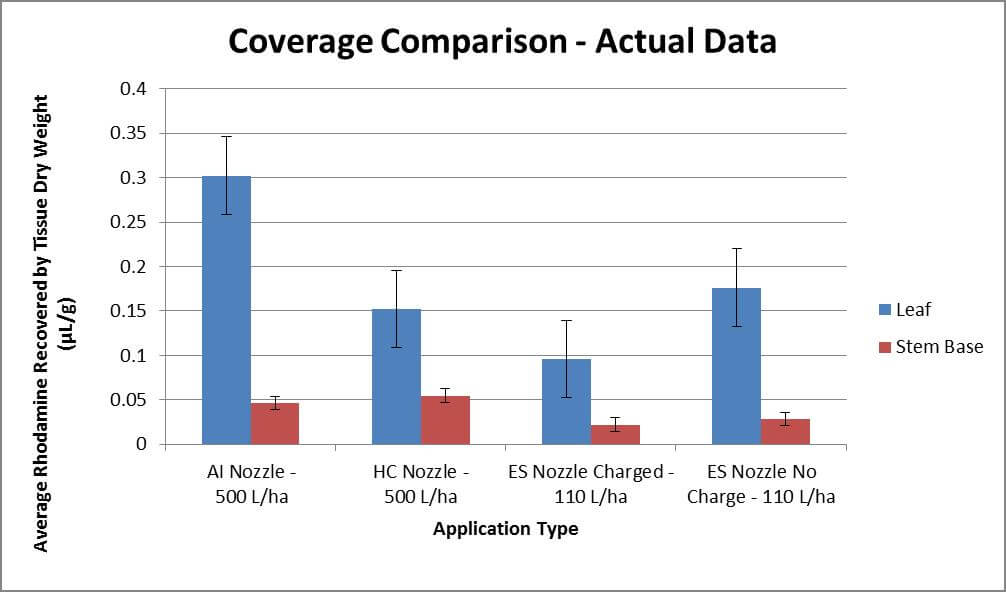
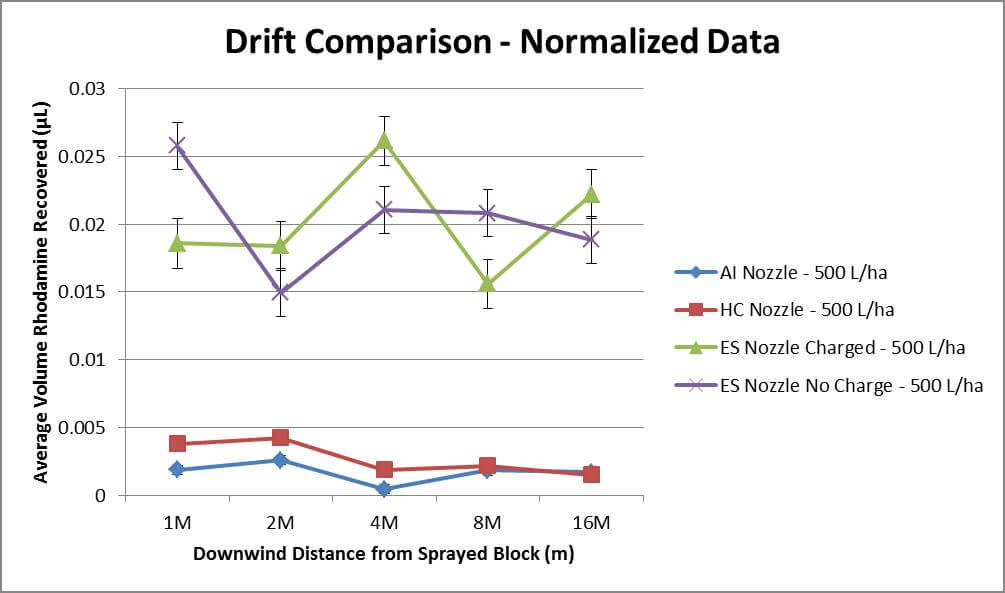
    The following graph shows the coverage observed in µL rhodamine per dry weight of tissue sampled. Bars represent standard error. Each treatment represents three passes (n=3) where each pass included three sub-samples averaged to offset the high variability inherit to spraying. While statistical analysis did not prove significant, there were strong trends. The AI nozzle deposited more dye on the leaves, while the HC and both electrostatic applications were par. Stem coverage achieved in conventional applications was approximately double that of the electrostatic. However, note that the electrostatic system only applied 1/5 of the volume sprayed conventionally.

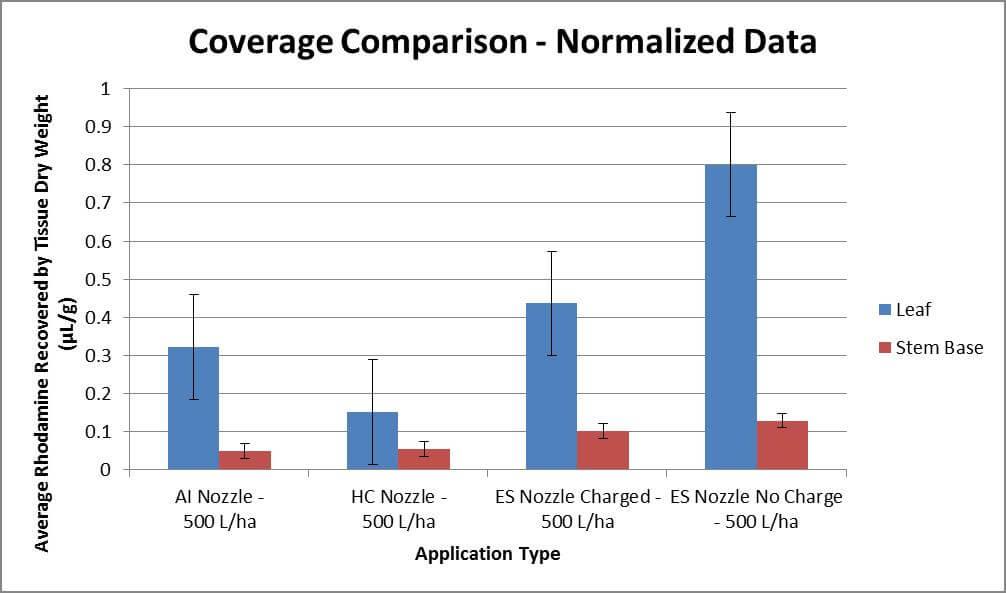
    When the data is normalized to depict a 500 L/ha application for all treatments, a different story emerges (see below). Now foliar coverage is 25-100% better for electrostatic applications than conventional. Stem coverage is twice that of conventional. Unexpectedly, the uncharged electrostatic treatment outperformed the charged treatment on the leaves. This might be the result of variability in the application, or the result of coronal discharge which can occur when pointy leaves repel charged droplets. This suspicion might be supported by the similar coverage achieved on the stems in both Treatment 3 and 4. You can read more about the Corona Discharge Effect in this article.

    Regarding drift, we will focus on the normalized data (where all treatments are adjusted to 500 L/ha). An analysis of variance indicated with 95% confidence that the electrostatic treatments drifted significantly more than conventional (approximately 5x more rhodamine detected). Particle drift follows an inverse square rule, where levels decline with distance, but the decline is only minor in all treatments. This may be a function of weather conditions, coupled with the limited distance investigated.

    Winds averaged 6.5 km/h gusting up to 10 km/h at boom height. Temperatures were between 15-17°C and relative humidity at ~70%. These conditions are conducive to drift as droplets are less likely to evaporate and in the case of Very Fine droplets, travel great distances. Many drift studies extend to 300 m from the point of application, whereas we were unable to monitor beyond 16 m. The downward trend would likely have been observed were we able to sample further downwind.

    Observations

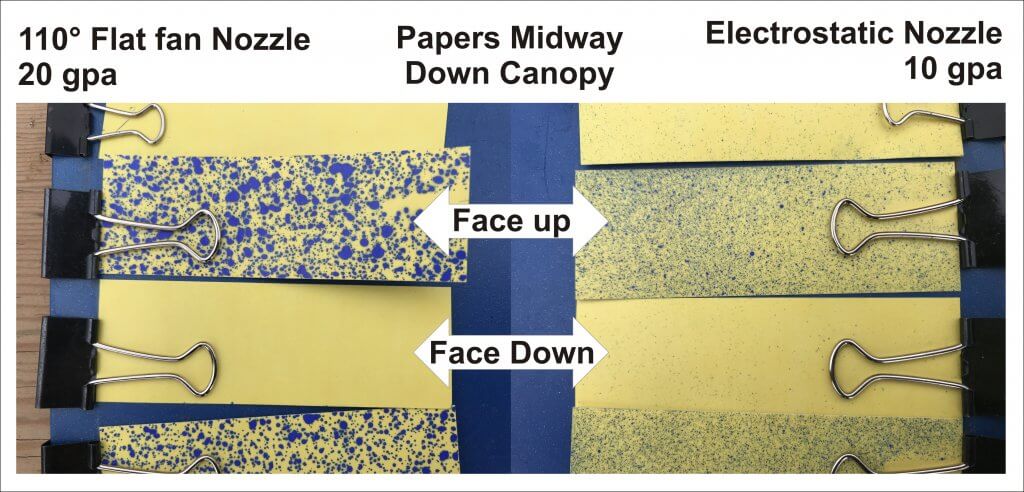
    Our data supports the manufacturer’s claim that the electrostatic sprayer has the potential to match the coverage from a conventional application while using 50% less water and pesticide. It is unclear whether the electrostatic charge plays a role in this coverage, or if it is the result of the Very Fine spray quality and air assist (which have been demonstrated to improve canopy penetration). Further, it is unclear whether the charge may actually have been detrimental in the carrot crop. Claims of improved coverage uniformity were not explored in this study, but observations of water-sensitive paper in soybean (see image below) did indicate consistent under-leaf coverage, even at 50% application volume.

    The five-fold increase in drift potential is a significant barrier for this technology. The spray cloud is comprised of like-charged particles that expand in three dimensions, which improves coverage uniformity and penetration into the canopy, but also causes droplets to expand up and out of the canopy. Air assist is used to propel them downward, but the turbulent 9.4 m/s windspeed seemed excessive, even for a dense carrot crop.

    It is possible that focussing and reducing that airspeed may also reduce drift without compromising coverage. Presently, the air shear design of the Ecostatik’s MaxCharge nozzles prevent the operator from reducing the air speed without compromising spray quality. And, even if air speed could be reduced, the spray quality must remain Very Fine to achieve an optimal mass-to-charge ratio, and will therefore always carry an inherently high drift potential.

    Thanks to Kevin Van der Kooi for spraying, and Laura Riches, Tamika Bishop, Terisa Set, Christine Dervaric, Claire Penstone and Aki Shimizu for sample collection. Special thanks to Cora Loucks for assistance with statistical analysis and Martin Brunelle of MS Gregson for providing the Ecostatik for evaluation.

  • Adjuvants in the airblast tank

    Adjuvants in the airblast tank

    Spray adjuvants are tank mix additives that either physically or chemically influence the efficacy, consistency or safety of pesticides. For example, adjuvants can improve the handling characteristics of a spray solution (e.g. water conditioners, de-foamers, emulsifiers). They can improve uptake into a target plant and/or improve the amount of contact between spray droplet and target surface (e.g. non-ionic spreaders). They can also modify droplets to reduce the potential for wastage from drift or run-off (e.g. anti-drift additives, stickers).

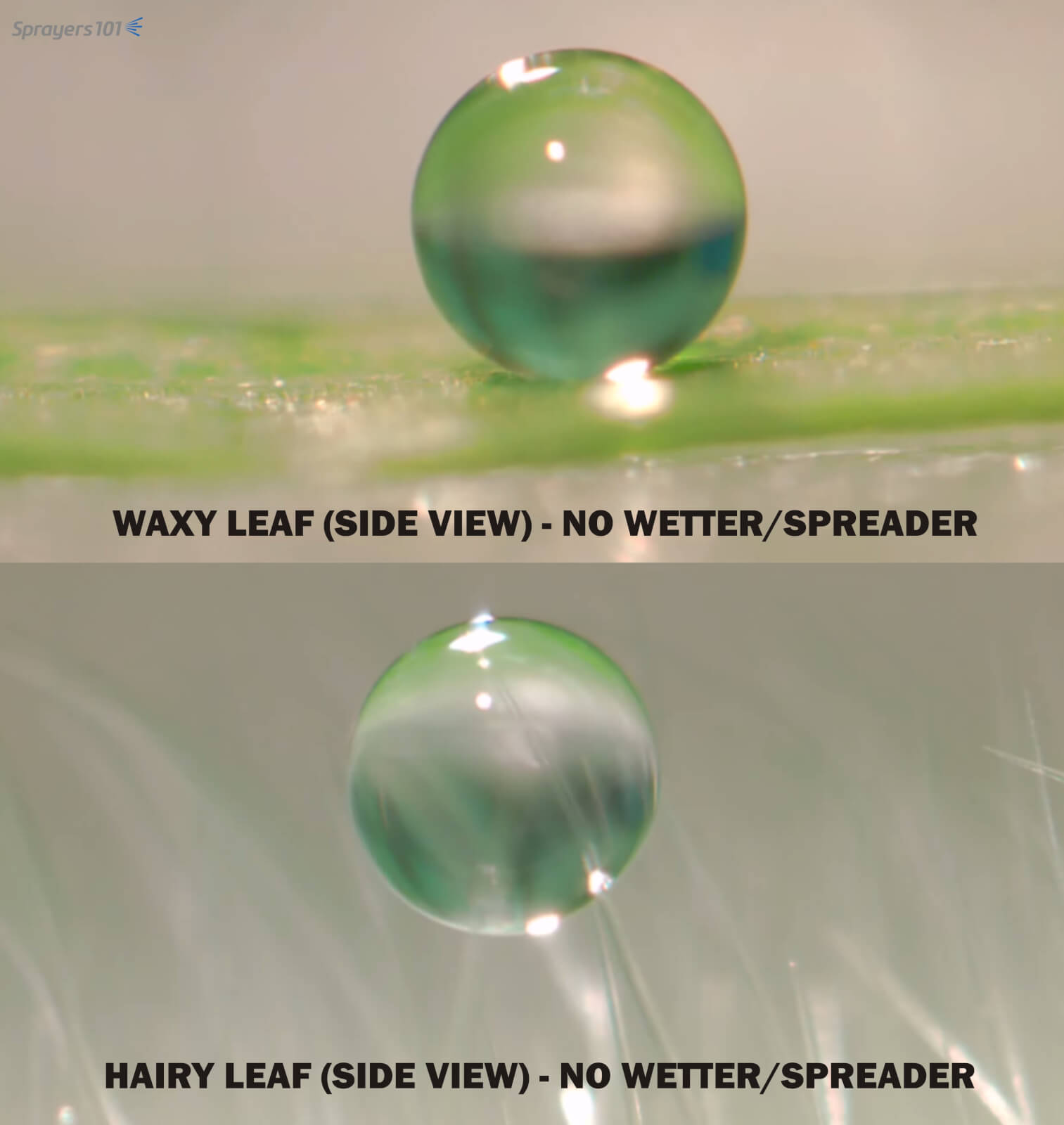
    Note how little of the droplet contacts a waxy leaf (above). This hydrophobic reaction between water and wax can be overcome using a non-ionic spreader. Similarly, note how the droplet gets hung up on the trichomes (hairs) on a leaf before it reaches the leaf surface (below). Again, a non-ionic spreader would reduce droplet surface tension allowing it to splash onto the leaf. Photo Credit – Dr. H. Zhu, Ohio.
    Note how little of the droplet contacts a waxy leaf (above). This hydrophobic reaction between water and wax can be overcome using a non-ionic spreader. Similarly, note how the droplet gets hung up on the trichomes (hairs) on a leaf before it reaches the leaf surface (below). Again, a non-ionic spreader would reduce droplet surface tension allowing it to splash onto the leaf. Photo Credit – Dr. H. Zhu, Ohio.

    Some pesticide labels require the use of adjuvants in the tank mix for the pesticide to work correctly. They are not formulated with the product because of expense, bulk, or product stability, and must be added during loading. In order for a pesticide to work as advertised, it is important to include any adjuvants required by the label. In some cases, we are encouraged to use adjuvants to improve an application, even though they are not on the label.

    There are potential benefits to introducing some unlabelled adjuvants, but there are also potential problems. The difficulty is that unless someone tests a specific tank mix combination for a specific crop, the results cannot easily be predicted. For example, when a tank mix is incompatible, an adjuvant could cause phytotoxicity, create more drift when used with the wrong nozzle, deactivate or enhance a tank partner, and/or potentially reduce spray coverage.

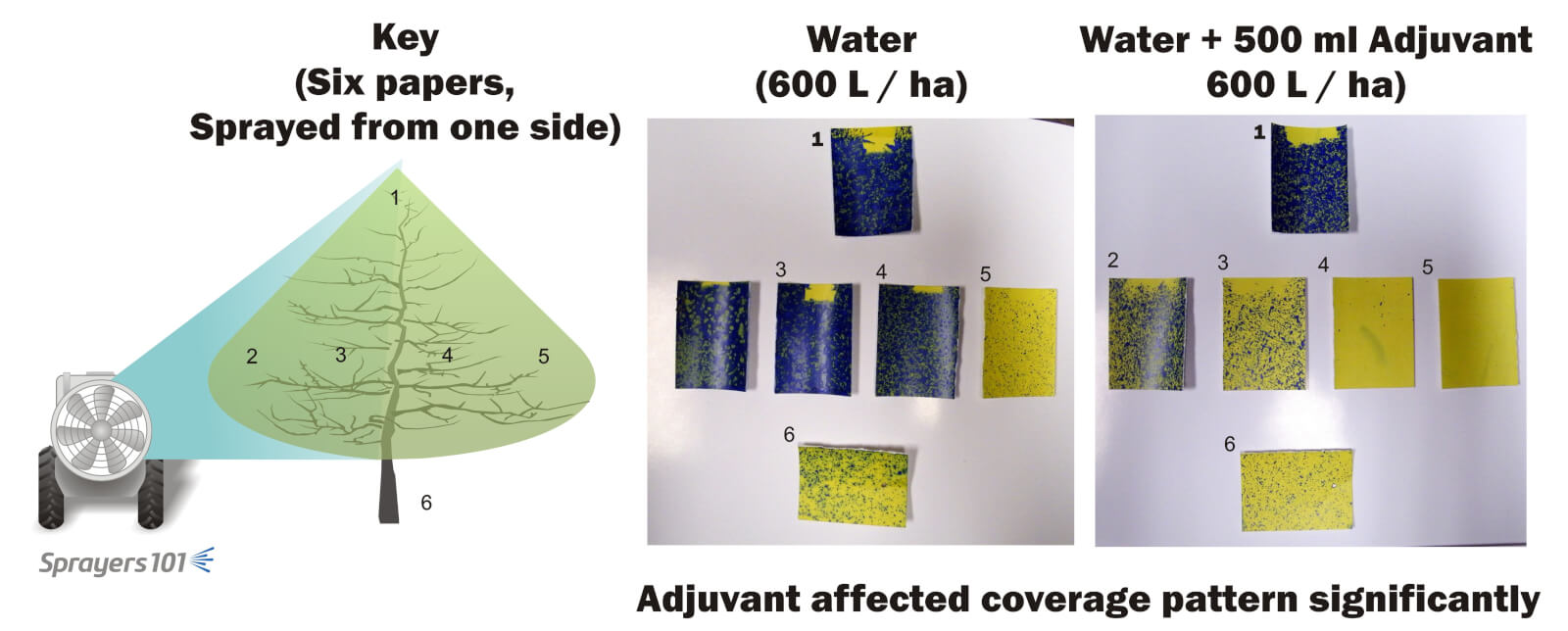
    We once conducted a trial to test a deposition utility modifier intended to reduce run-off and drift. Water-sensitive papers were placed in the canopies of a 40 year old McIntosh orchard, which was then sprayed from one side in late May. The papers in the left panel (dilute control) were sprayed with 600L/ha (~60 g/ac.) of water. Those in the right panel (adjuvant) were also sprayed with 600L/ha but included the label rate of 500 ml of adjuvant. The water-plus-adjuvant reduced drift and runoff, as advertised, but did not penetrate as deeply into the canopy or spread on the papers, which is a concern if the operator was performing alternate-row middle spraying or needed better coverage (e.g. for mites). It was an unexpected side effect.

    For better or worse, even small amounts of adjuvants can have a significant effect on spray coverage. Always test spray coverage when using a new adjuvant in a tank mix.
    For better or worse, even small amounts of adjuvants can have a significant effect on spray coverage. Always test spray coverage when using a new adjuvant in a tank mix.

    We also investigated the use of an anti-drift adjuvant in airblast sprayers, which you can read about here.

    There is no simple answer regarding unlabelled adjuvants; there are too many possible product/adjuvant/plant combinations. If you intend to experiment with an adjuvant, perform a jar test to test for physical incompatibility. Then spray a small volume of the tank mix on a few trial plants to ensure there are no unexpected chemical issues (e.g. phytotoxicity or inactivating tank mix partners) or coverage issues.

    It is highly recommended that every sprayer operator have a copy of Purdue Extensions’ 2015 “Adjuvants and the Power of the Spray Droplet – PPP-107”. This comprehensive handbook describes of how water quality and adjuvants affect the performance of pesticide applications. I consult it regularly.

    Here are two videos from Dr. H. Zhu, USDA-ARS Ohio, showing how adjuvants that affect surface tension can help improve the level of contact between spray droplet and target surface.

  • Diagnosing Airblast Coverage

    Diagnosing Airblast Coverage

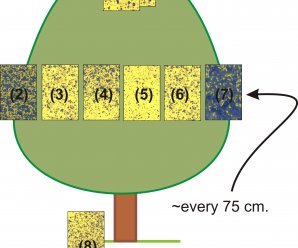
    Assuming there are no mechanical or maintenance problems, water-sensitive paper can be used to diagnose sprayer performance. Go here to read more about water-sensitive paper. Interpreting the results and knowing what changes to make is the critical part of the process. Observing no coverage, or a sodden paper, make for obvious conclusions… but what about everything in between? Here are the ground rules:

    First: Only ever test coverage in environmental conditions you would normally spray in. Temperature, humidity and wind speed can make or break an airblast calibration.

    Second: When altering sprayer settings, only make one change at a time for each test pass so you can isolate what’s wrong.

    Third: Each pass requires a new set of papers located in the same place, oriented the same way, distributed throughout the canopy. Mark their locations with bright flagging tape and write the pass number and canopy position on the back of paper prior to placement. This helps you to compare the passes later on. Don’t collect papers until they’ve had an opportunity to dry a little, or they will smear and stick together.

    Fourth: Pass down one alley first. Have a look at the papers without removing them. Then, spray the target canopy from the other side. Now the papers can be removed for analysis. This order is important because it reveals the impact of wind direction and the cumulative effect of spraying from both sides. In some cases, the sprayer operator may wish to travel an additional upwind alley to reflect the cumulative coverage on a typical spray day. Alternate row applications are not recommended.

    This Turbomist has been outfitted with sensors that detect the presence of a canopy. Each eye corresponds to a boom section, turning the section on and off as required and improving efficiency. If it’s not there, why spray it?
    This Turbomist has been outfitted with Gillison’s Sonic Spray sensors that detect the presence of a canopy. Each eye corresponds to a boom section, turning the section on and off as required and improving efficiency. If it’s not there, why spray it?

    Once the papers are retrieved, it’s time to diagnose the coverage. The following situations are typical in calibrations, and possible fixes are suggested. Remember, this is a process that takes time. Several passes may be required before satisfactory coverage is obtained. Once the correct settings are determined for the block, continue to use them until there is a significant change in the crop staging or weather. At that point, repeat the process.

    Seven Situations

    Situation One:

    <15% coverage and <85 Fine/Medium droplets/cm2 at top of target (e.g. tall targets such as hops or trees). Suggested Fixes:

    • Wind might be stealing fine droplets. Try Coarser droplets (e.g. using air induction nozzles). Be aware that you may have to increase volume to compensate for reduced droplet counts and that they may fall out of the airstream before reaching distant targets.
    • Deflectors may not be channelling air and spray correctly – extrapolate air direction using ribbons on deflectors.
    • Fan may have to be set to higher gear, or if using GUTD, return to 540 rpm to increase fan speed. If still insufficient, you may need a sprayer with higher air capacity.

    Situation Two:

    <15% coverage and <85 Fine/Medium droplets/cm2 deep in canopy – sometimes papers on outside of canopy are visibly wet. Suggested Fixes:

    • Ground speed may be too high. Use flagging tape indicator on far side of target and see if air is getting through.
    • Canopy maintenance may be required (e.g. pruning, hedging, leaf stripping, etc.). No sprayer can consistently penetrate really dense canopies.
    • Fan may have to be set to higher gear, or if using GUTD, return to 540 rpm to increase fan speed. If still insufficient, you may need a sprayer with higher air capacity.
    • Increase carrier volume.

    Situation Three:

    Papers are drenched, dripping or show channels of running liquid. Suggested Fixes:

    • Reduce spray volume, either overall or in key locations on the boom corresponding to the drenched papers.
    • Ground speed may be too low. Use flagging tape indicator on far side of target and see if too much air is getting through. If so, increase ground speed.

    Situation Four:

    Considerable overspray beyond target row. Suggested Fixes:

    • Turn off upper nozzles until spray JUST clears target.
    • Deflectors may not be channelling air and spray correctly – extrapolate air direction using ribbons on deflectors.

    Situation Four:

    Considerable blow-through beyond target row. Suggested Fixes:

    • Slow the fan speed by shifting to low gear, or using GUTD method
    • Ground speed may be increased as long as coverage is not compromised. Use flagging tape indicator on far side of target and see if air is getting through.

    Situation Five:

    Ground under target row is drenched. Suggested Fixes:

    • Rotate lower nozzles slightly upward, but do not shut them off. If ground remains drenched, turn them off entirely. Each hollow cone produces up to an 80º spray angle, so the next higher nozzle often compensates by spraying lower than expected.
    • Deflectors may not be channelling air and spray correctly – extrapolate air direction using ribbons on deflectors.

    Situation Six:

    <15% coverage and <85 Fine/Medium droplets/cm2. Remember that this coverage threshold is only a point of reference, not a hard fact. It does not apply when using Coarser droplets. Suggested Fixes:

    • Increase spray volume, either overall or in key locations on the boom corresponding to the under-sprayed papers.
    • Wind might be stealing fine droplets. Try coarser droplets (e.g. using air induction nozzles). Be aware that you may have to increase volume to compensate for reduced droplet counts.
    • Ground speed may be too high. Use flagging tape indicator on far side of target and see if enough air is getting through. If not, decrease ground speed.
    • Canopy maintenance may be required (e.g. pruning, hedging, leaf stripping, etc.). No sprayer can consistently penetrate really dense canopies.

    Situation Seven:

    Inconsistent coverage on outer edge of canopy (e.g. one spot never seems to get spray.) Suggested Fixes:

    • Nozzle spray angle may be too acute (e.g. full cones), and spray is not overlapping before reaching target. Try wider spray angles.
    • Some tower sprayers have ‘dead spots’ in their air. Check for limp or flagging ribbons tied to nozzle bodies and/or deflectors. Deflectors may need to be adjusted, or adjacent nozzle body angles repositioned to compensate. Try an air induction nozzle in the dead zone.
    • Canopy may be brushing against nozzles as the sprayer passes, temporarily blocking them. Canopy management required.
    Some sprayers, such as Rears, Turbomist, FMC or this Durand Wayland have an option for electronic ‘eyes’ that detect spray targets. The boom will shut off completely if there is a gap in the planting. This can save a great deal of wasted spray. It is less applicable in trellised plantings where it has been known to be “fooled” by wires and posts.
    Some sprayers, such as Rears, Turbomist, FMC or this Durand Wayland have an option for electronic ‘eyes’ that detect spray targets. The boom will shut off completely if there is a gap in the planting. This can save a great deal of wasted spray. It is less applicable in trellised plantings where it has been known to be “fooled” by wires and posts.

    If you still are unable to achieve satisfactory coverage, you may have to consider more extreme solutions. You may have an under- or over-powered sprayer. You may have to perform significant canopy management. Or, you may be trying to spray in poor weather conditions.

  • Spraying Sweet Corn

    Spraying Sweet Corn

    This article was written with information from George Hamilton, Field Extension Specialist with New Hampshire Cooperative Extension (retired), and from Dr. Ben Werling, West Michigan Vegetable Educator with Michigan State University Extension.

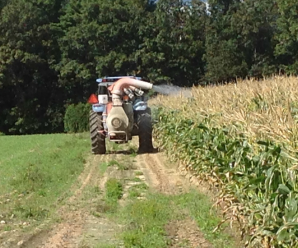
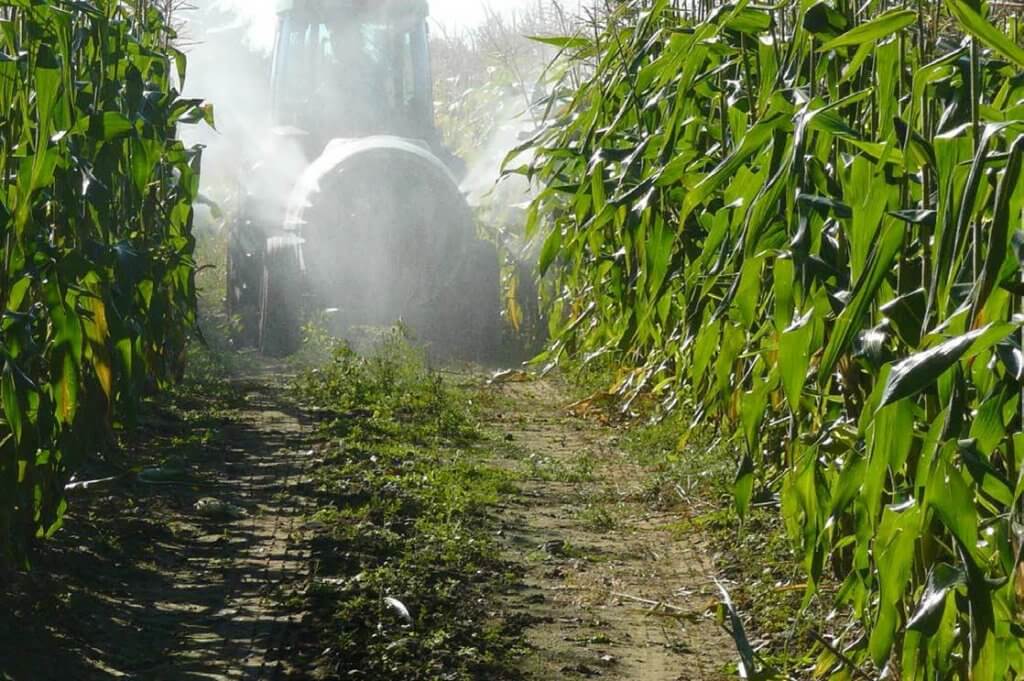
    Commercial sweet corn growers must use spray application equipment capable of depositing spray material at the ear zone. These producers often hail from small, diversified vegetable and fruit farms that sell direct to the customer. For example, in 2013 New Hampshire’s Hillsborough County had about 500 acres planted to sweet corn. The seven farms ranged from 35 to 80 acres, and five of those farms also had orchards. Only one farm used an over the row (high clearance) sprayer, while the rest managed equipment costs by using their orchard airblast sprayers. While uncommon in Ontario, airblast application continues to be a very common practice in the US.

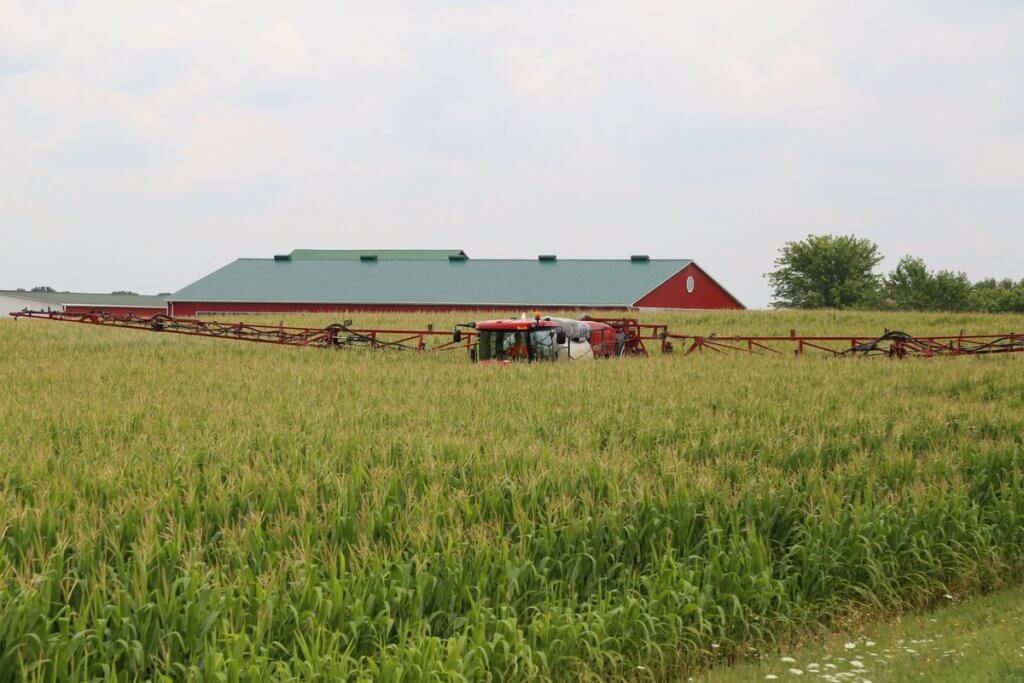
    High clearance in corn. Photo: FS Partners’ Juli Paladino

    So, if high clearance or aerial application isn’t an option, what are the limitations of using a directed application from an airblast sprayer? George wanted to find out, so he used water sensitive paper to compare coverage when spraying mature sweet corn plants.

    Water sensitive paper clipped to corn silks.

    He first sprayed an 18 row, and then a 16 row block using a Jacto cannon sprayer.

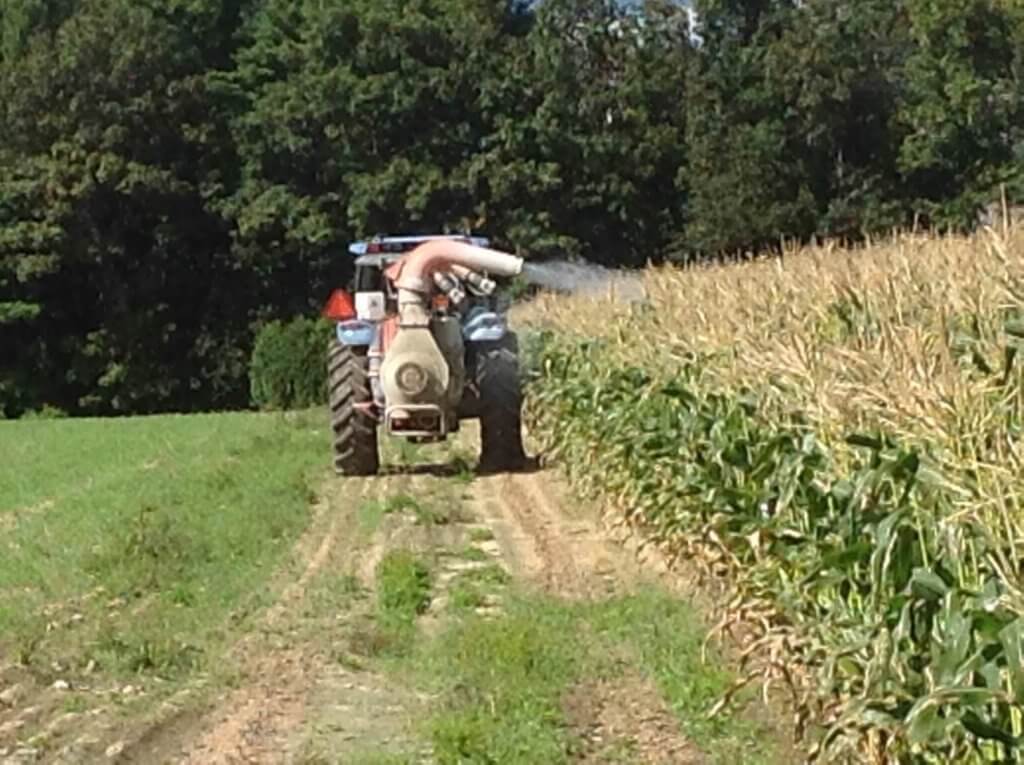
    Jacto cannon sprayer in action.

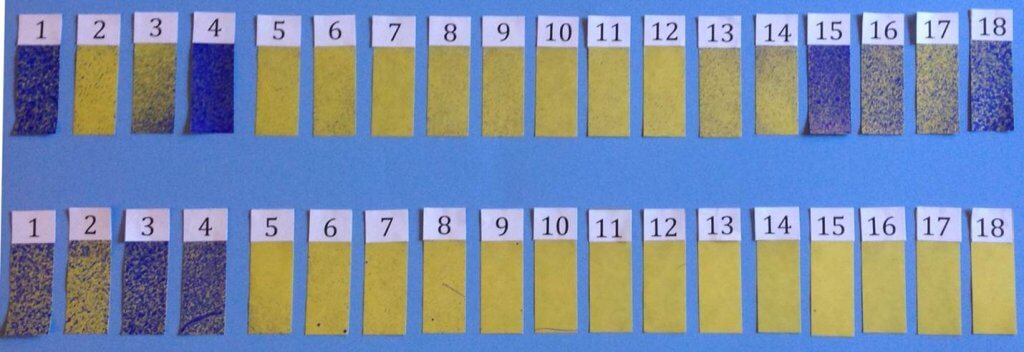
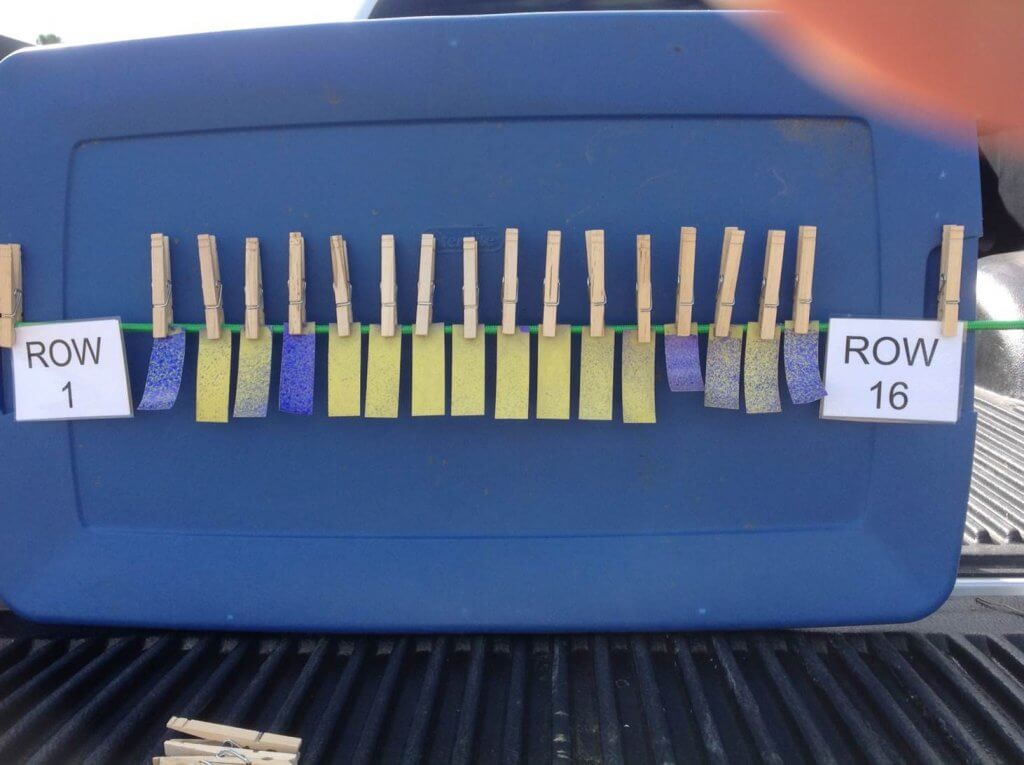
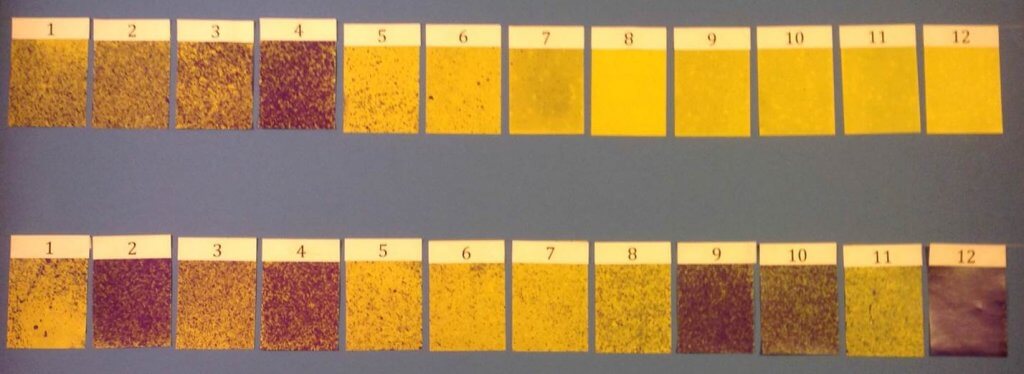
    The following photo shows (qualitatively) the resultant coverage. The top row shows the coverage when the sprayer drives both sides of the 18 row block. The bottom row shows the coverage from driving on only one side of an 18 row block. Three observations:

    1. Coverage is excessive adjacent to the cannon (row 1 or 18), improves further along the swath (rows 2-4 or 15-17), and then becomes erratic or non-existent with distance (see block sprayed from one side).
    2. Spraying from both sides improves coverage in the middle 10 rows.
    3. Spraying from one side does not provide sufficient coverage beyond row 7 or 8.
    Results from Jacto spray passes in 18 row block. Top: Driving both sides. Bottom: Driving only one side.

    They then used the cannon on both sides of a 16 row block to see if a shorter swath would improve coverage in the centre rows. It is a little difficult to discern from the photo, but the beyond the four outer rows, the centre rows have far better coverage.

    Jacto Cannon Sprayer spraying from both sides of a 16 row block.

    Finally, they used a more conventional axial Durand-Wayland airblast sprayer to spray a 12 row block from one side, and then from two.

    Durand-Wayland airblast sprayer in action.

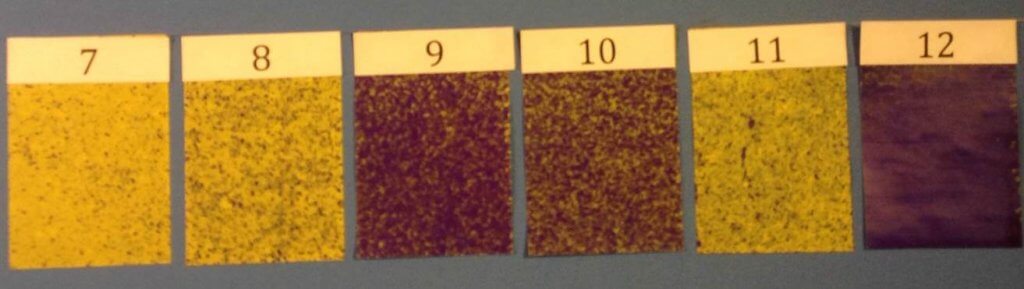
    Once again, a shorter swath distance improves coverage in the middle rows, and spraying from one side results in poor coverage uniformity.

    Results from DW spray passes in 12 row block. Top: one side only. Bottom: Both sides.
    Close-up of DW performance spraying from both sides in 12 row block.

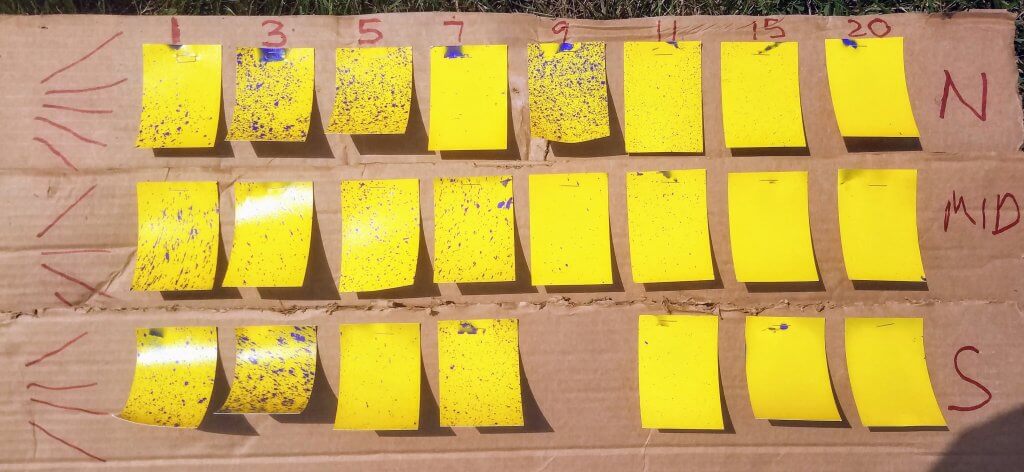
    In 2018, Ben also tried tackling the airblast / sweet corn combo. He and a grower used an AgTec cannon to spray from one side into a block of 5.5′ high corn on 30″ centres. They were travelling about 4 mph and spraying 50 gpa. Water-sensitive papers were placed at the top (N) middle (MID) and bottom (S) of the ear zone on rows 1,3,5,9,11, 15 and 20 rows to the west of the sprayer’s path. He used the Snapcard app to determine cover (see table).

    Rows from sprayerCoverage (Mean %)
    112
    319
    514
    77
    116
    153
    203

    Further observations:

    1. Coverage appears to be reasonable up to about row 5.
    2. The top card in row 9 caught spray falling into the crop (aka the up-and-over technique) but it didn’t penetrate any lower.
    3. Spraying from one side also showed how a stray leaf in the way of the card makes a big difference (see card at the top of row 7).

    Watch the video of Ben and the grower spraying water:

    So what’s happening?

    In both George’s and Ben’s trials, we see that spray droplets lose forward momentum as a function of distance from the nozzle. Fine droplets, typical of airblast sprayers, require air to carry them to the target. When the air produced by the sprayer slows, they begin dissipate and move erratically. Now, consider that the corn canopy itself is acting like a filter, scrubbing the spray from the swath as a function of distance. This is further exacerbated by environmental conditions such as wind, humidity and thermals.

    What’s the solution?

    In Ontario, we’ve tried directing cannons both laterally and downward (the up-and-over technique) in highbush blueberry, grape and cedar nurseries. We’ve tried increasing air speed, slowing sprayer travel speed and increasing spray volume. In each case we incur excessive coverage near the sprayer, extend the reasonable coverage zone a bit, and have only a modest improvement as the spray inevitably slows and is filtered.

    So, we feel the best approach for spraying sweet corn with an airblast sprayer is as follows:

    • Spray from both sides (even if you must cut an alley to accommodate the sprayer). This also helps with access for harvest.
    • For two or three head cannons, blocks between alleys should not exceed 16 rows to allow sufficient spray coverage of the ear zone. The sprayer head must be pointed downwards.
    • For axial airblast, or if spraying tall varieties with a cannon, consider 12 row blocks.
    • Any style of air-blast sprayer requires 75 gpa (or more) for sufficient coverage, and both travel speed and air settings should ensure air movement reaches the middle of the block.