Note: There have been updates to Canadian regulations governing drones since this article was written. For updates, please refer to this article.
Introduction
In Canada, the use of drones for pesticide application, otherwise known as RPAS, is regulated by two Federal Departments: Transport Canada establishes regulations for safe operation and Health Canada for the registration and conditions of use of pest control products.
Drones are already used in Canadian agriculture for crop surveillance and livestock management, and they’re being used to apply granular fertilizers, for pollination, for frost protection and greenhouse shade management. The use of drones for general spraying was cleared by Transport Canada in July 2017. In 2018, Health Canada stipulated that the use of RPAS for pesticide application is not allowed under the Pest Control Products Act (PCPA) without sufficient data to characterize the hazards or risks associated with this use. You can read the updated (as of June, 2023) Pest Management Regulatory Agency Information note on the subject of pesticides applied by drone, here.
At this time this article was written, only three pest control products were registered for application by RPAS in Canada. These were restricted-use microbials (two granular and one liquid) intended for larval mosquito control. Their labels were expanded to include RPAS in the fall of 2022 but as of 2023 no province or territory has yet permitted their application. International RPAS working groups (e.g. the OECD working party on pesticides and drones) comprised of academics, the agrichemical industry, government regulatory agencies, and both drone manufacturers and operators, are working collaboratively to assemble the evidence-based information we need to inform the expansion of other pesticide labels. These studies include:
comparative evaluations of efficacy
operator and bystander exposure studies
drift studies
residue studies, and
technical evaluations of how environmental, topographical, and operational parameters affect the above
In parallel, several groups are working to develop pesticide safety certification and training materials. Pesticide training and certification programs across Canada are based on the Standard for Pesticide Education, Training and Certification in Canada. Canadian provinces/territories are responsible for the training and certification of pesticide vendors and applicators based on these standards. A national core manual for RPAS operator is anticipated.
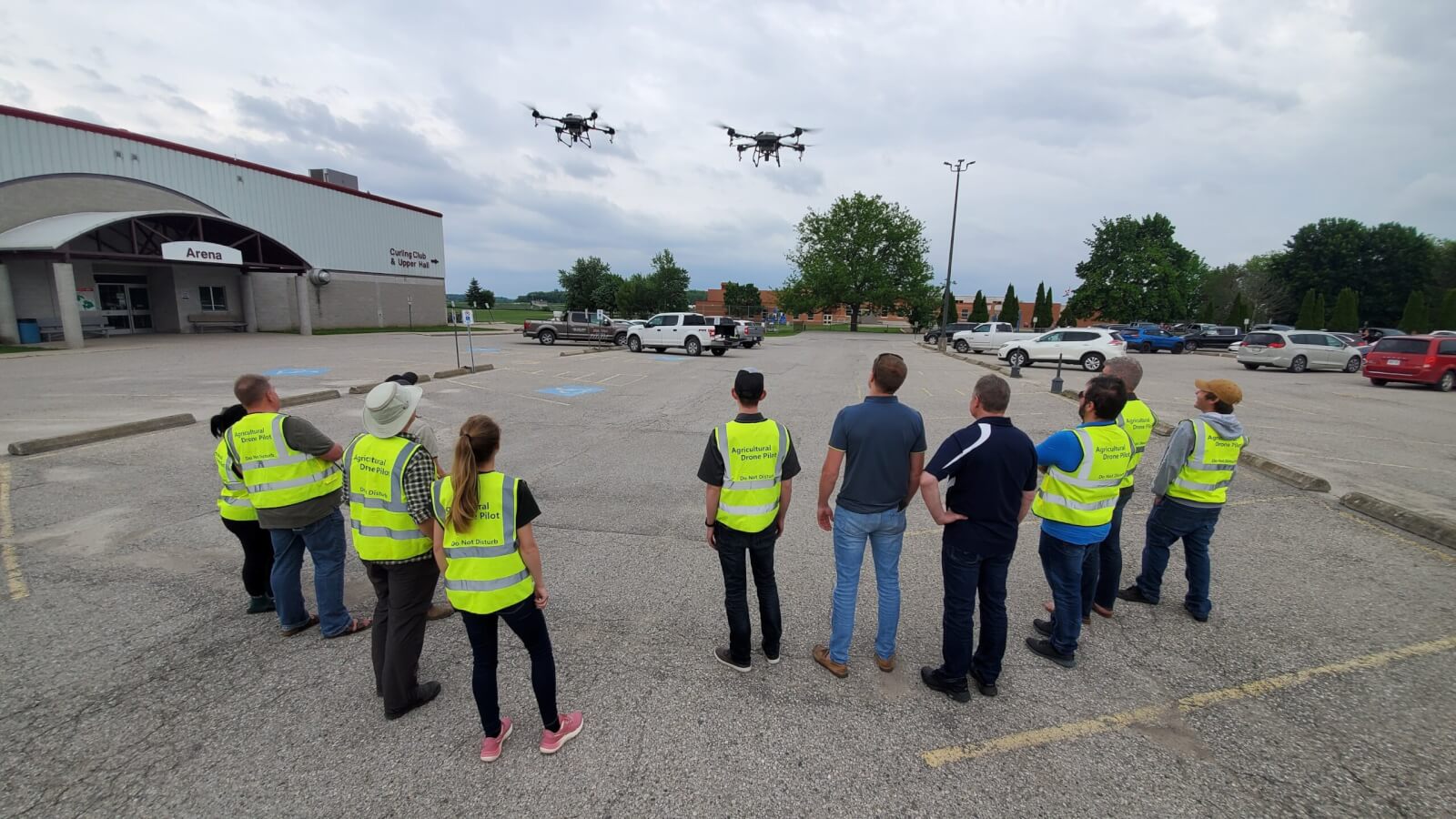
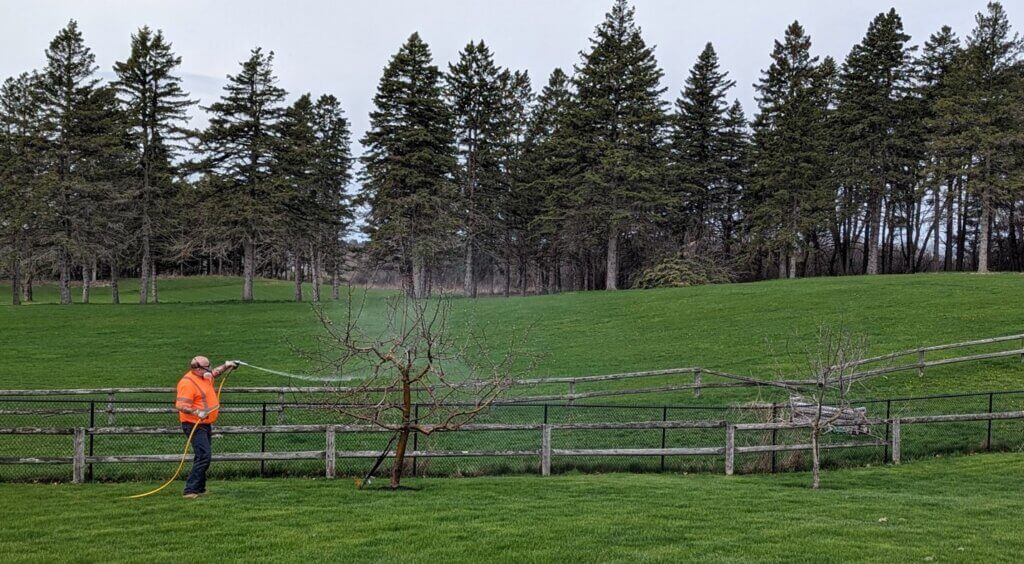
A candid moment from one of the many Health Canada-authorized RPAS research programs happening in Canada.
Registration and Certification
Anticipating future pesticide label expansions, perhaps you’re planning to buy and fly a RPAS. Pilots must register their drone (online for a $5 fee) and display that number on the drone. For more information, the Canadian Aviations Regulations (CARs) covers drones here. It’s a massive document, so jump to the end to find the relevant information under Section IX.
Transport Canada requires all pilots with RPAS over 250 g to obtain a Pilot Certificate, either for Basic Operations or for Advanced Operations. In some cases, pilots may also have to apply for Special Flight Operations Certification (SFOC), which must be approved before the mission can take place. See below for details.
Basic Operations Pilot Certificate
The Basic Operations certificate allows pilots to operate any drone from 250 g up to and including 25 kg. This allows the pilot to fly:
Outside controlled airspace
No closer than 100 ft laterally from bystanders
In VLOS (or in contact with someone in VLOS)
Over 1.8 km from heliports
Over 5.6 km from airports
If you’d like to explore the requirements, Transport Canada has an online document called TP15263 which describes required knowledge for Basic Operation pilots of small RPAS. Personally, I took a $100 online course (from a Canada-based drone flight school) to help me prepare for my exam. A good course will supply you with what you need to know about the laws, the environment, the aircraft, and your responsibilities as a pilot.
The $5 exam has 35 multiple choice questions. You have 90 minutes to complete it and you need a 65% to pass. It was a surprisingly challenging exam, so don’t be discouraged if you don’t pass on your first try. You can take another swing at it after 24 hours, and you’ll encounter new questions randomly drawn from their database.
Advanced Operations Pilot Certificate
The Advanced Operations certificate allows pilots to operate any approved RPAS over 25 kg in VLOS. This allows the pilot to fly:
Inside controlled airspace
No closer than 16.4 ft laterally from bystanders
Under 16.4 ft above bystanders (essentially directly overhead)
In VLOS (or in contact with someone in VLOS)
Within 1.8 km from heliports
Within 5.6 km from airports
There are two parts to this certification. The $10 exam requires an 80% to pass, covers more topics than the Basic Operations exam, and has the same 24h wait to retry. You must also undergo a Flight Review with a certified trainer, who changes about $200 for the service. Once the exam and flight review are successfully completed, there’s a $25 issuing cost. Be aware that flying a drone over 25 kg will also require an SFOC.
Special Flight Operations Certificate
In some cases pilots will have to apply for a Special Flight Operations Certificate (SFOC). Based on the CARs part IX regulatory structure, examples include operating a drone over 25 kg, flying at an advertised event, operating with foreign credentials (i.e. not a Canadian pilot) or operating outside the rules for Basic or Advanced operations, such as Beyond Visual Line-Of-Sight (BVLOS). Note, the requirements surrounding SFOC’s are under review as Transport Canada reassesses weight classes and streamlines the process, which can take weeks or months to complete. The new requirements are anticipated in late 2023 or early 2024 in Canada Gazette 2 (the 2019 update to Gazette 1 can be found here).
Recency
Once you have your Certificate(s) you must carry a copy with you while flying. Technically, Pilot Certification doesn’t expire, but you still have to maintain it. According to CARs 901.56, pilots cannot operate a drone unless they have successfully completed the following within 24 months preceding the flight:
Testing / Issue of their pilot certificate (Basic or Advanced).
A Flight Review
Any of the recurrent training activities set out in section 921.04 of Standard 921. This is an online questionnaire that has the answers posted right after each question. Don’t ask… just comply. Be sure to print it out after you complete it because it doesn’t save the answers.
Just like the Certificate, the pilot must have Proof of Recency with them at all times. Unlike certification, it’s free.
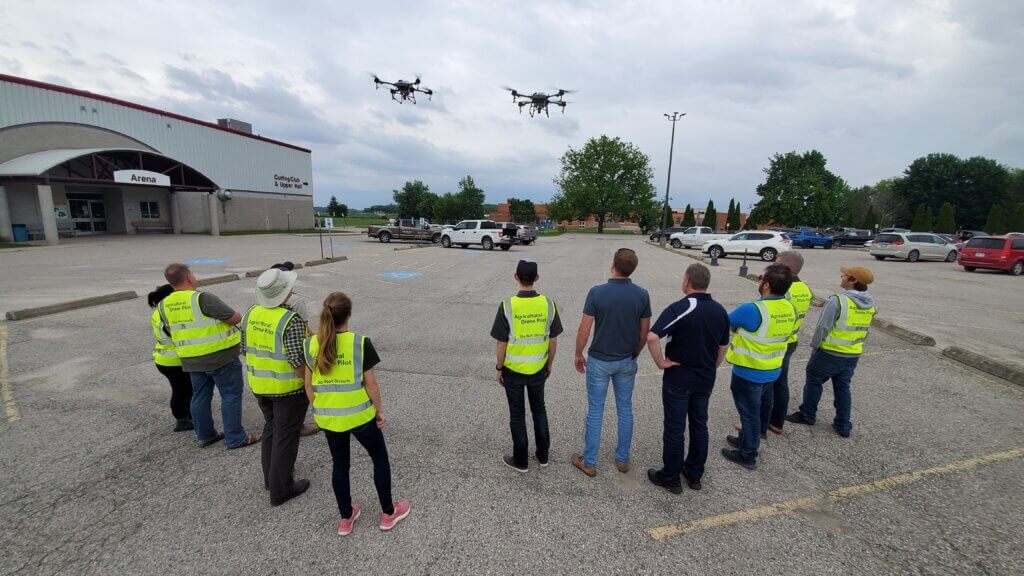
Learning from one another at a 2022 RPAS workshop in Southern Ontario.
Records
Every owner of a remotely piloted aircraft has to keep certain records. They need to be with you while flying for a certain period of time and all records must be transferred with the system if you sell or give it to a new owner.
The name of the pilot(s) and crew involved with each flight, noting time and date (keep with you while flying for 12 months).
Any maintenance, modification or repair of the RPAS, including precisely who did what and when. This should detail the instructions used to complete the work (keep with you while flying for 24 months).
Fines and Enforcement
Fines for contravening regulations range from a maximum of $3,000 for an individual to a maximum of $25,000 for a corporation. The RCMP and local police are part of the enforcement team.
Crop Protection Products Registered in Canada
This list is subject to change. To date, there are no pest control products registered for use in agriculture in Canada. There is no distinction between personal (i.e. home farm) and custom application. It is currently illegal to spray a registered agricultural product by drone. There are, however, two liquid formulation pesticides registered for non-agricultural use:
VectoBac 1200L – A biological larvicide intended for black flies and mosquitoes that must be applied over water sites. Label expanded in 2023.
Garlon XRT – A herbicide registered for industrial applications (e.g. controlling woody plants and vegetation in non-crop settings, such as around power lines and other utilities). Label expanded in 2024.
Final Thoughts
Get certified before you buy your RPAS, and do your research before you commit to a system. Rotor-based RPAS design is changing rapidly as manufacturers adapt to the demands of North American and European applicators. We once thought a swarm of lightweight, nozzled drones would be the path to success, and now the industry is leaning towards larger solitary drones with payloads over 40L and rotary atomizers instead of conventional nozzles.
Be sure you understand what they can and what they cannot do. Only buy from a reputable dealer with practical spraying experience, and not someone with slick advertising that over-promises RPAS work rate, swath width, reduced drift or improved coverage potential. Ask to see data and remember, at the time this article was written: In Canada, it is currently illegal to spray pesticides in agriculture from a drone, whether it is on your property or not.
Any description of airblast sprayer start-up must, contextually, make assumptions on how it was winterized for long-term storage. This cyclic relationship is why I use a chicken-and-egg title slide when giving this presentation.
Answer: It was the rooster.
The inability to describe one process without the other is further complicated by the possibility that the sprayer is brand new and was therefore never winterized. So, what follows is an attempt at a logical sequence of pre-season maintenance activities to restore a winterized sprayer, or initiate a new sprayer.
New Equipment
If this is a new sprayer, you have an opportunity to perform some preventative maintenance.
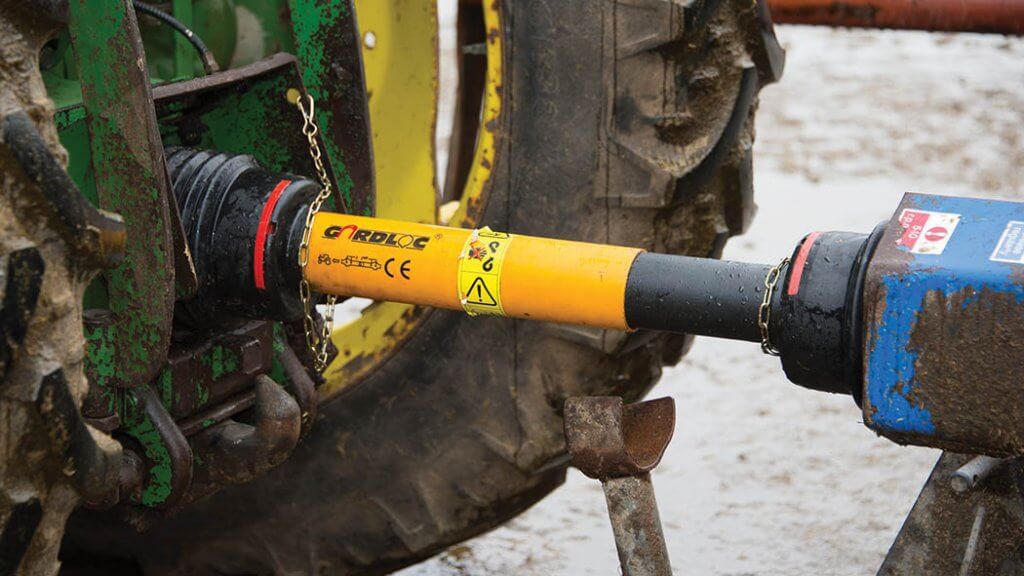
Loosen, lubricate and re-tighten clamps. Always back gears off before tightening to avoid stretching them. (Image from Purdue Extension publication PPP-121: Preparing Spray Equipment for Winter Storage and Spring Startup)Use double clamps on pressurized lines for added safety. Wider clamps are better and T-bolt clamps are better than worm-gear.Put thread release on bolts and re-tighten with a torque wrench (not an impact tool). Use a paint pen to mark nut, washer and bolt for future visual checks. This is called a “Witness Mark”.Protect hoses and wires at rub points. Follow hoses and with a paint pen, number the hose-ends and connections for future reference.Using a new tractor? You may have to re-calibrate to account for different gear ratios. When hitching a new sprayer, note that the distance from the ball on the drawbar hitch to the tip of the PTO should be ~14″. Don’t exceed maximum working angles for PTO shafts (usually <25 degrees). If your tractor or implement manufacturer says differently, go with that. And get it in writing.
Winterizing (Long-term storage)
If you are preparing the sprayer for long-term storage, follow the normal rinsing process, but don’t reinstall strainers and nozzles.
Look in the nozzle bodies for debris. Discard worn or broken nozzles.Soak, scrub, rinse and store nozzles and nozzle strainers. You may replace them once the sprayer is clean, but I prefer to store them separately since they have to come back off during start-up.
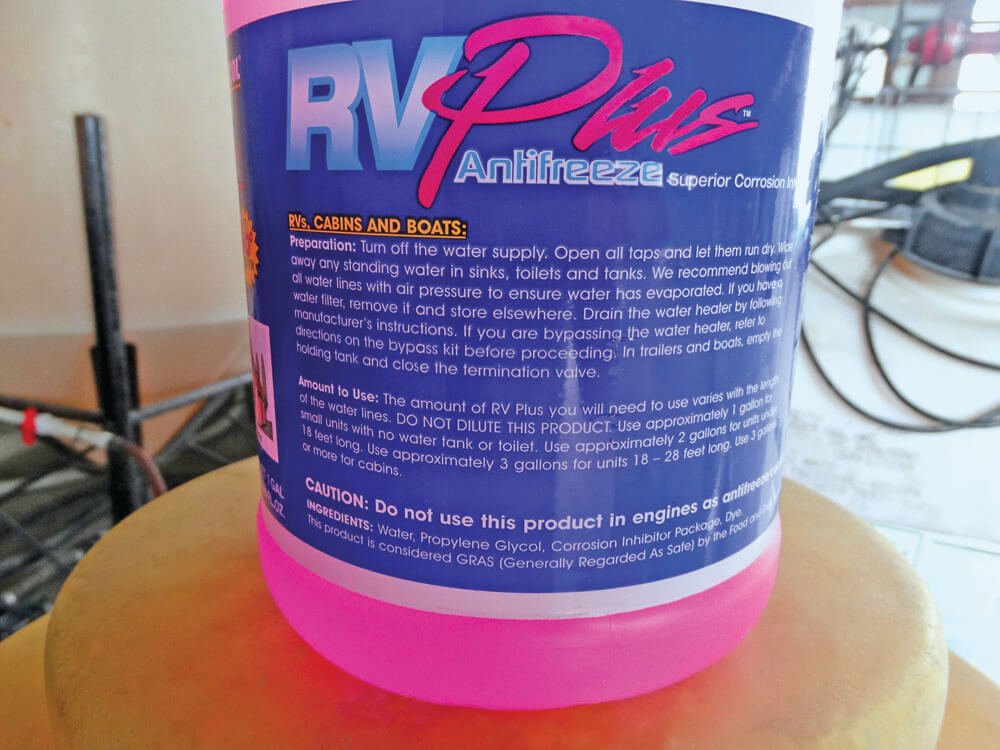
With the agitation on, circulate undiluted plumbing antifreeze (the sprayer already has 5-10 L (1.25-2.5 gallons) of water in the system from the decontamination process) for five minutes and drain it through the plumbing system (not the booms).
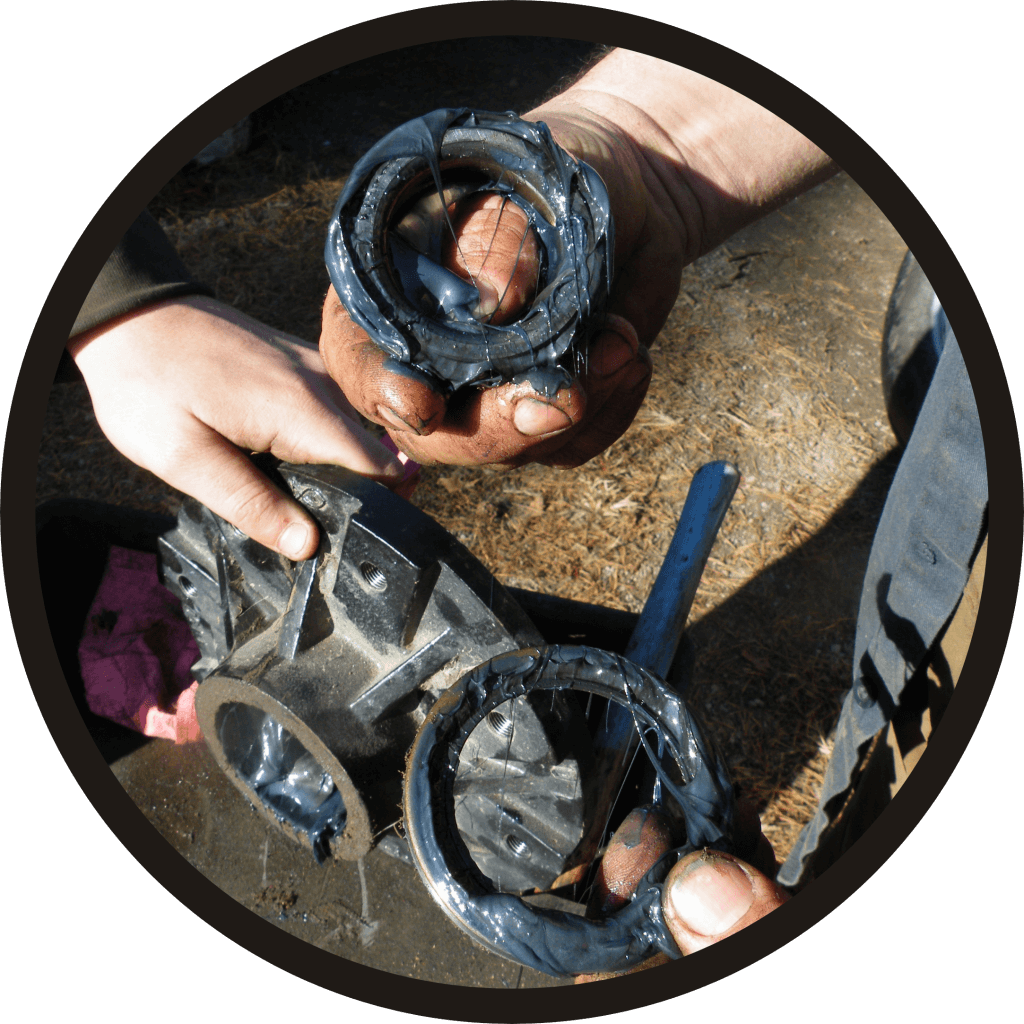
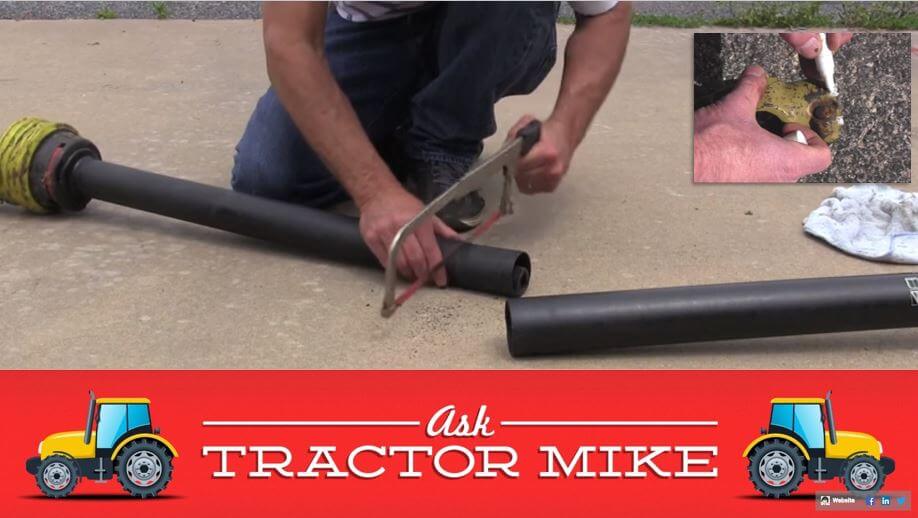
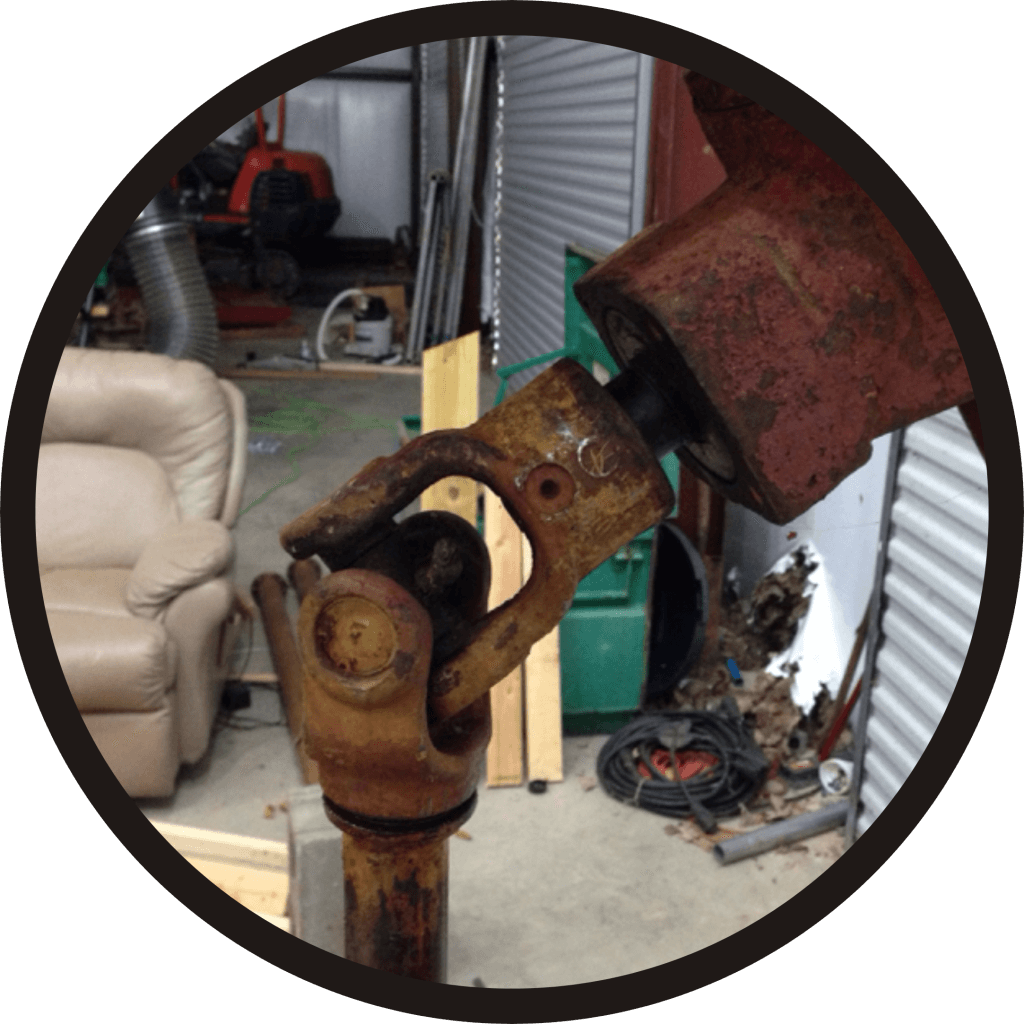
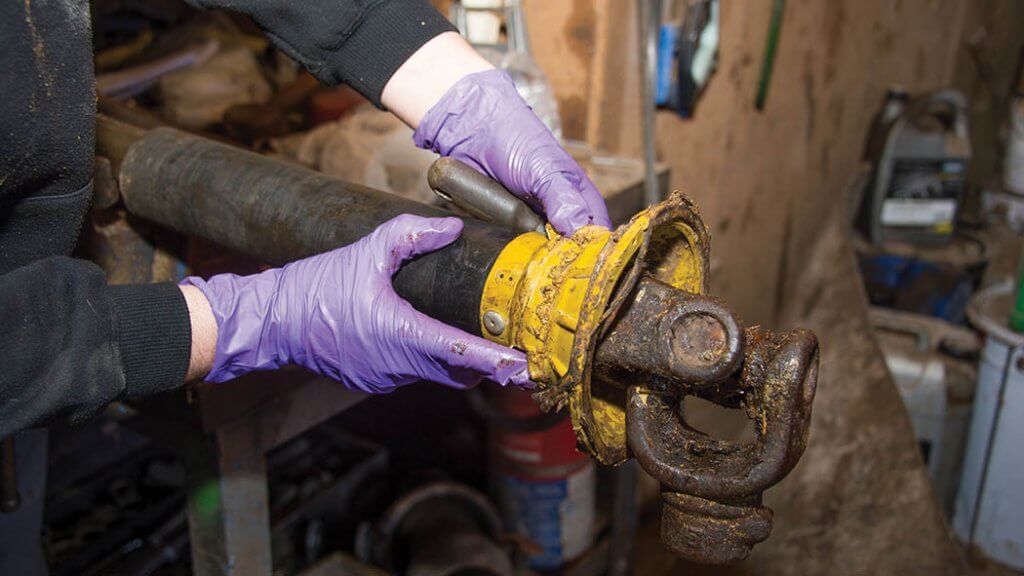
Disconnect hoses where they attach to the booms and drain as much liquid from the sprayer as possible. (Image from Munckhof Sprayers). Take the time to examine any hose fittings.Clean the sprayer (Triple rinse with a detergent) and scrub the exterior. Do not use pressure washers on bearings, fittings, pumps or any lubricated or moving parts.Examine fan blades for cracks, build-up or nicks that can cause imbalance. Replace (not just repair) punctured entrance grills.Don’t ignore tank damage. Poly tanks are prone to sun damage and cracks. Never climb into a tank to repair it. Quite often, replacement is the best option.Clean and inspect wheel assemblies. It’s best to do this during winterization to prevent bearing corrosion as the sprayer sits all winter.Remove any rust and repaint (or just touch up). Paint not only looks good, it protects.The excellent YouTube channel Ask Tractor Mike proposed storing the PTO shaft indoors in two pieces, and to cut away a portion of the interior guard to facilitate reassembly later on. Also, use a paint pen to mark the splines on the shaft for easier hook-up (see inset top-right of image).RV antifreeze is a 50% solution of antifreeze and water with a rust inhibitor. It should not cause phytotoxicity if sprayed or dumped, but be sure to dispose of it away from water sources during start-up. Turn the pump manually to get antifreeze throughout the system. Close the nozzle bodies, loosely fit the tank lid and store indoors. (Image from Purdue Extension publication PPP-121: Preparing Spray Equipment for Winter Storage and Spring Startup).
Spring Start-up
Most operators are guilty of neglecting their airblast sprayers and babying their tractors. Sprayers are precision tools that must be kept in good operating order to prevent costly breakdowns, improve their performance, and increase their lifespan.
Your car is serviced based on distance travelled. Your sprayer should receive regular maintenance based on working hours, per the manufacturer’s recommendations. Daily sprayer inspections are part of regular maintenance since the operator will (hopefully) find small problems before they become big problems.
Never assume your sprayers is ready to go right out of long-term storage. Parts seize, scale breaks away from surfaces, and small beasties sometimes choose to eat, or make their homes in, cozy sprayers.
When planning spring start-up, never assume the winterized sprayer is ready for immediate hook-up. Expect a minimum half day per sprayer.Attempting to loosen or shift something that hasn’t moved in several months is risky. Pressure gauges snap off, fittings crack, welds break. Expect the unexpected and either have spare parts on hand, or a plan to get them quickly.Parts are most likely to seize during the first spray. Bearings and PTO universal joints, especially.Start-up is a good time to lubricate parts. Grease the guard ring bearing every 100 hours, the universal joint cross every 25 hours and the shaft and shear bolt regularly.Insects, birds and rodents eat, or make homes in, sprayers. Professional rodent bait/traps, steel wool and peppermint oil/gel are possible solutions.Check belt tension, alignment and wear. (Image from Purdue Extension publication PPP-121: Preparing Spray Equipment for Winter Storage and Spring Startup).
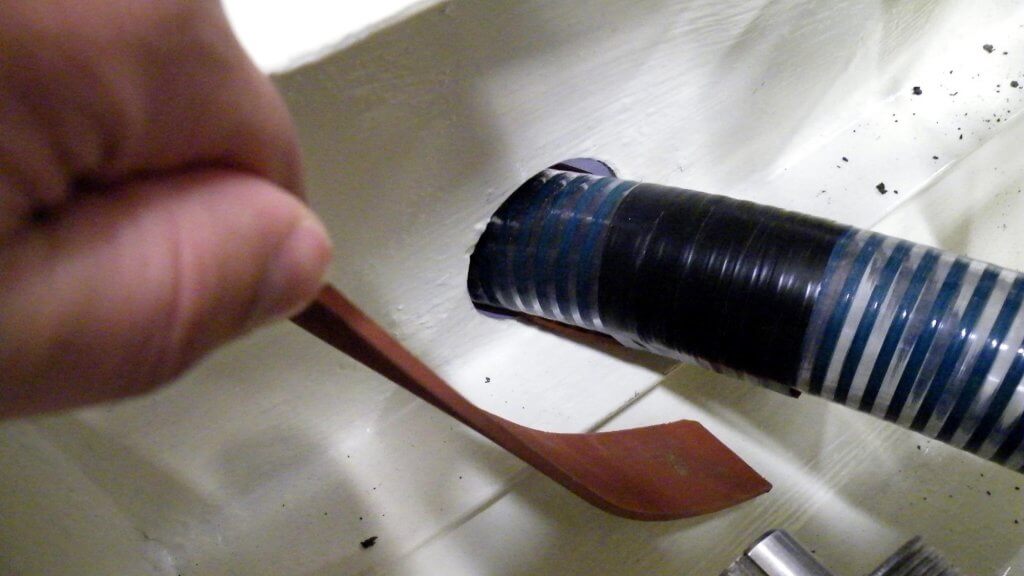
Pump specific maintenance is beyond the scope of this article. Hypro recommends changing oil after 40 hours of break-in operation and every 500 hours after that. The diaphragms should be replaced every 1,000 hours. Generally speaking, EPDM (black) diaphragms are a better choice for airblast sprayers, while the Desmopan (amber) diaphragms are really for lawn care sprayers.
Pump maintenance is beyond this article, but change the oil every 500 hr or 3 months. Use a paint pen to write on the pump what type of oil it requires, and then date the filters. Note the “winterized” sticker.
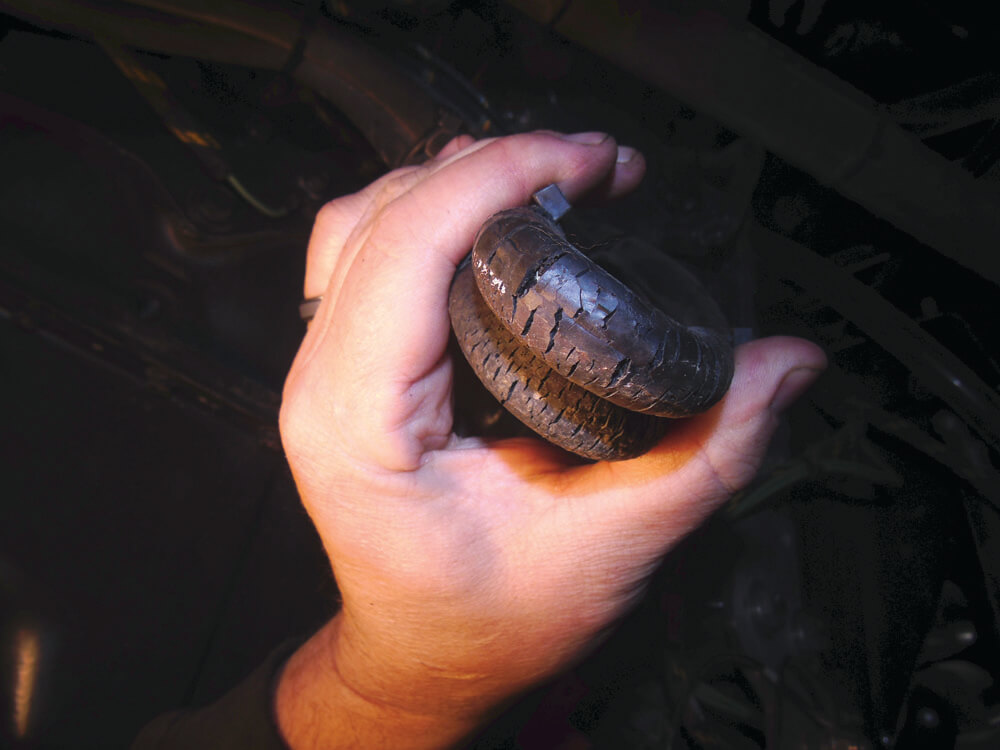
At minimum, check the tire pressure. Hard tires drive faster, but leave compacted ruts. Soft tires drive slower, but disperse weight better. Airblast sprayer wheel assemblies should be cleaned and inspected as part of regular annual maintenance. Wheel bearing maintenance before long-term storage may prevent water from corroding the bearings.
Ensure tire pressure matches the ideal stamped on the tire. Or, if using less pressure to avoid spring soil compaction, ensure both tires have the same pressure.
The relief valve on your sprayer should always be in the bypass position during start-up. If your gauge spikes then the gauge may always read high afterwards and should be replaced.
A reminder to always set the relief valve to the bypass position when starting up the sprayer. This is one reason why pressure gauges spike and can eventually fail.
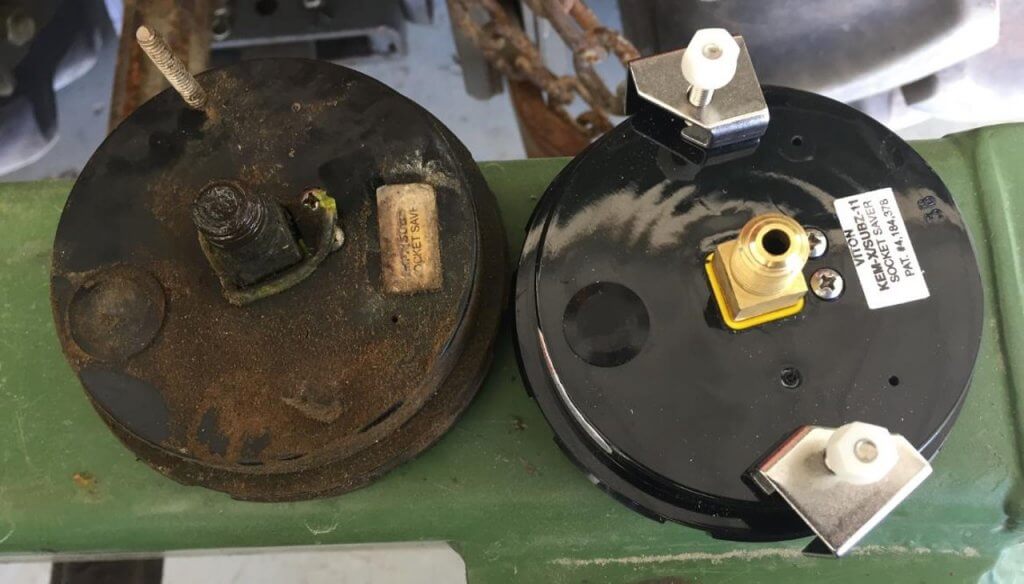
Replacing leaking, opaque or inaccurate gauges improves sprayer performance. Be sure to use the oil-filled variety of gauge to eliminate a bouncing needle. You can also get suppressors that fit between the gauge and sprayer to prevent pulsing. Consult the article on testing airblast pressure gauge reliability.
Use a wrench to turn gauges at the nut. Don’t twist them by hand holding the face. Ensure they are not opaque, leaking, plugged or resting above the zero pin.
Many spray materials do not mix well and one of the common causes of uneven application is poor agitation. If you find deposits at the sump in the bottom of the sprayer after an application, your agitation is insufficient. For mechanical agitators, check for propeller wear and ensure paddles are secure on the agitator shaft. Learn more about agitation here.
If the agitator shaft is leaking a little, tighten the packing. The packing gland is a common source of leaks. Keep it properly greased. If a leak occurs you can usually repair it by tightening the bolts on the packing gland by ½ a turn, but if that doesn’t work you may have to remove and repack (or replace) it.
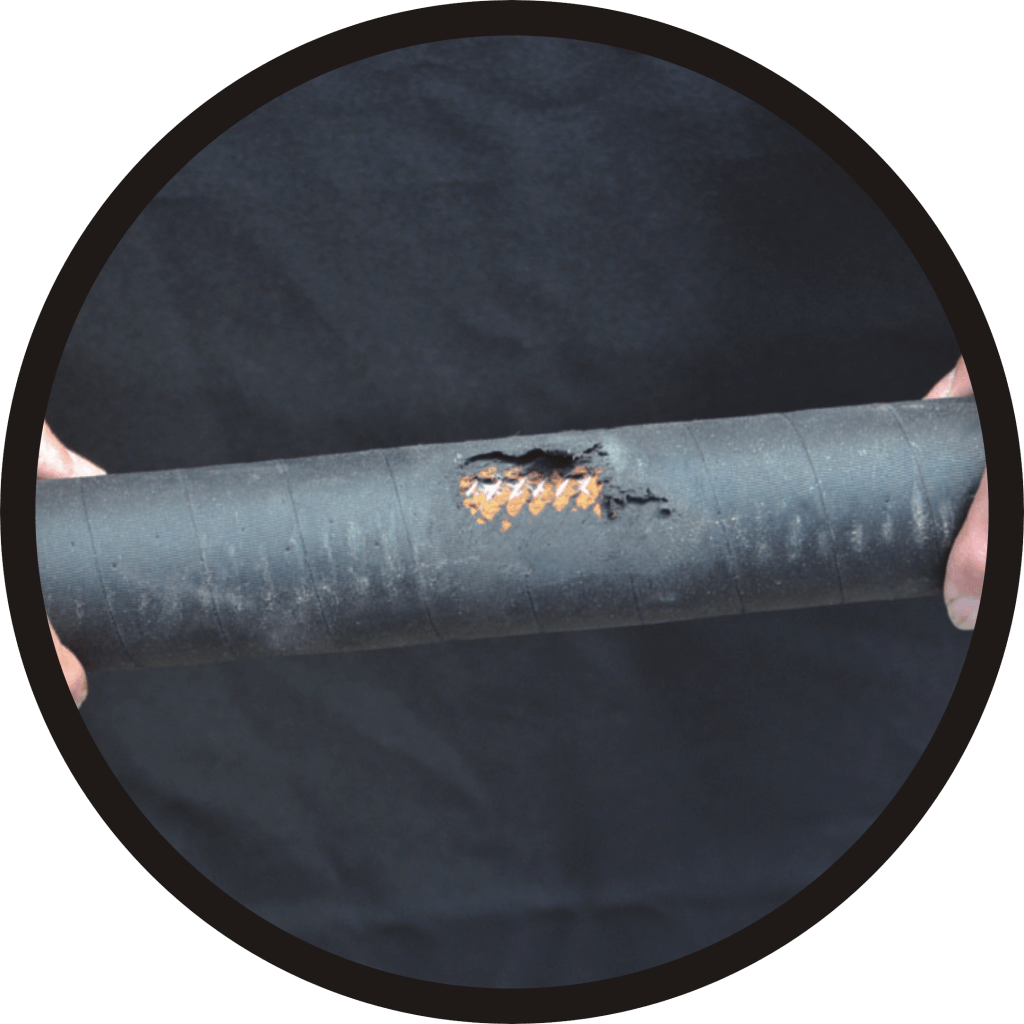
On sprayers with mechanical agitators, look for prop wear and loose or damaged paddles. Fill the sprayer with water and looks for tank leaks. Tighten the bolts 1/2 turn if the packing gland on the agitator shaft is leaking. You may have to remove and repack the gland if the leak persists.Look for signs of hose wear and examine the sprayer for leaks while under pressure. Be careful when pressurizing the sprayer for the first time in the spring; this is when lines are likely to come loose or burst. (Image from Purdue Extension publication PPP-121: Preparing Spray Equipment for Winter Storage and Spring Startup).Minerals chelate (i.e. scale) more readily on stainless steel than plastic tanks. In either case, the first tank of water and leftover antifreeze should be sprayed from the nozzle bodies with no line or nozzle strainers, and no nozzles. Replace them once the tank is sprayed out.
The last step is calibrating the sprayer, and that process really depends on your definition. If the preceding steps conflict with those of the manufacturer’s, always follow the manufacturer’s. Do this for reasons of safety and to preserve any warranty.
Thanks to Fred Whitford (Purdue University), Gail Amos and Mark Ledebuhr (Application Insight LLC) for reviewing the content of this article and for their helpful edits.
I was excited. Today would be my first in a series of drive-along experiences with Ontario sprayer operators. However, to get from my home in Southwestern Ontario to Newmarket, I would have to cross Toronto. This is not my favourite thing to do. But, Dean Solway, Plant Healthcare Supervisor with Shady Lane Expert Tree Care, was based out of Mount Albert and he liked to start at 6:00 am. So, a hot shower and a hot coffee (not necessarily in that order) gave me the emotional support I needed to throw elbows on the parking lot we call the 401.
It was strangely unsettling to see Tim Horton’s closed, and equally odd to see only a handful of cars on the highways. That may have been the fastest, smoothest drive through Toronto that I’ve ever had.
5:45
I arrived at the 10-acre lot that has been owned by the company for the last 45 years. I walked past a small, 500 tree nursery they’d recently planted to find Dean in the office. He was busy checking bookings for the day and assigning jobs to his three Plant Health Care trucks (PHC1, 2 and 3). More on those later. After a few introductions, I faded into the background and let them get on with things.
Dean was ensuring the routes made sense and that everyone was ready to go. He explained that the week’s bookings were set each Friday, but that things could always change at the last minute. Front-line administration would handle client calls and communicate with the trucks throughout the day. They also ensured the clients were given at least a day’s notice that someone would be coming to treat their plants. Interestingly, the company is also required to inform the client’s neighbours. Dean said it helped avoid potential conflicts such cars, sunbathers or laundry left in the path of potential overspray. Not that such things ever happen, of course.
Operators kept referring to “The Board” which showed their daily assignments. With 2,800 clients scatted over Brechin, Barrie, Oakville, Pickering, Oshawa and downtown Toronto, thoughtful planning and clear communication were critical requirements.
I eavesdropped as Dean talked to a new hire about safety. Filter checks/replacements, face shields, gloves and orange vests were assigned, and I’m confident that it wasn’t staged for my benefit. Operator safety was a theme that came up throughout the day and it was clear Dean took it seriously. As the trucks got ready to roll, he fielded random questions about pesticide rates, tank mixes, crop staging and general agronomy as he double-checked that each truck was properly loaded.
I learned that standard operating practice was to regularly test the equipment and plumbing in each truck. Experience showed it was easier and less contentious to deal with minor leaks and similar issues in the yard than on a Toronto highway or even worse, at a client’s home. That took us outside.
6:15
Each truck was equipped with a tablet containing SDSs for all the products they use, PDFs of the pesticide labels and a hyperlink to Health Canada’s Pesticide Label Search website. Many of the products used by arborists are biorational / organic, either by choice or because labels do not permit the use of many conventional pesticides in urban environments. I felt a bit of team-pride when I was told that OMAFRA’s Pub 840 is a significant reference document for the company.
As he checked the trucks, Dean noted that it was important to explain to clients that eradicating pests isn’t always possible. Most often it’s about maintenance. For example, today would predominantly be about fungicide applications. Ornamental fruit trees such as crab apple were at risk of scab infection and the window for protection was narrow. Far be it for me to bring up climate change, but Dean did mention that this was the earliest he’d had to apply these products in nine years.
Protectant fungicide treatments need time to dry to be effective. If it were to start raining steadily inside two hours following the application, Dean said the client would be eligible for a re-application ASAP. According to OMAFRA Publication 840, four applications were permitted for this chemistry, and clients were scheduled to receive three at regular intervals over four weeks. That gave time for the applicator to rotate back around, and it left capacity for a possible re-application if required.
Incidentally, I am a master of foreshadowing.
The Trucks
PHC1 and PHC2 were designed to apply plant protection products. PHC3 was strictly for fertilizer and carried an extra 450 L just in case it was needed throughout the day. To remain flexible and efficient, the fertilizer applicators had to be able to take advantage of opportunities if the schedule changed. Returning to reload would be a big loss of productivity, so a little extra onboard was reasonable insurance.
Dean explained that all the trucks were filled either the morning of, or the night before, depending on the product. In the case of compost tea, it’s a three-day process that requires a lot of planning. It must be applied at less than 50 psi to prevent mechanical damage to the living component of the mix. It can be applied to the soil or as a foliar treatment.
We’d be riding in PHC1, which had a single tank subdivided into four separate 170-gallon tanks. The reel was a 60 amp electric auto reel with 300 feet of high-pressure hose. The pump was an AR 813 diaphragm pump, and the motor was a 20 hp twin cycle Vanguard and capable of producing up to 300 psi which is sometimes needed to reach the tops of the highest trees. Dean helped design this system himself and grinned when he said that even as low as 150 psi, you can feel the pistol “kick” in your hand.
Speaking of which, the hose terminated in a quick-connect that allows the operator to swap between a pistol for nearby targets, and a long-barreled rifle for more distant targets. There was also a manually pressurized two gallon bottle sprayer for when the hose-and-gun assembly simply wouldn’t reach.
The last thing Dean checked was that each truck had cleanup equipment, including detergents for any overspray accidents. He explained that most clients want no sign of the trucks coming, going, or having ever been there. That might mean washing away speckles on cars and windows, or marks from the hose being dragged on stonework or past beds and gardens. I’ll share my observations on how urban spraying seems to be viewed by the general public later on.
6:45
We’re on the road, passing through Newmarket in the York Region before slipping into stop-and-go traffic on the 404. We aren’t five minutes out before Dean’s phone rings. PHC1 is essentially his office, and he remains in communication via a work phone and headset, relying on a dedicated GPS to guide him from client to client… when the maps are accurate, anyway.
As we drive, Dean notes that rain is forecast so we’ll do as much as we can. He’s set up a linear route going to the furthest client first and working our way back. That way, if it does rain, it will be easier to reschedule because the clients are closer to the yard. He also designs routes that keep the trucks in single neighbourhoods. It’s more efficient and jumping on and off the 407 is an expensive proposition, so they use it judiciously.
7:40
According to the docket, we were slated to spray two 12-foot Siberian Crab-apples in the client’s back yard. We pulled up and hopped out. Dean walked us to the back of the house saying, “Let’s go find our patients”. I liked that.
The Process
Once located, he assessed the trees’ health to ensure the application was appropriate, and then scanned the area. He explained that an arborist had to be very mindful of the surroundings. He ensured nothing was in the path of the hose or the spray, established wind direction, and then (based on tree height and our distance from the truck) estimated the pressure we’d need for the pistol attachment to reach to the treetops.
We returned to the truck and Dean opened the side to put on his PPE. At the same time, he gave me a short safety lecture. Basically, if I saw anything leaking (on or under the truck) I was to turn off the engine immediately and we wouldn’t go anywhere until we figured out and remedied the issue. Also, should something happen to Dean, I was to call 911. Rest assured, there were no such issues that day.
He ensured the pressure regulator was completely backed off, opened the intake and return valves on the fungicide tank, attached the pistol to the hose and started up the motor. Then he adjusted the regulator to get us to 150 psi. It was obvious he’d performed this dance many times and as he went through the motions, he noted that it was important to get comfortable with the equipment but to always be respectful of it. Then he partially-closed the side panel to reduce the motor noise and started dragging out enough hose to reach his patients.
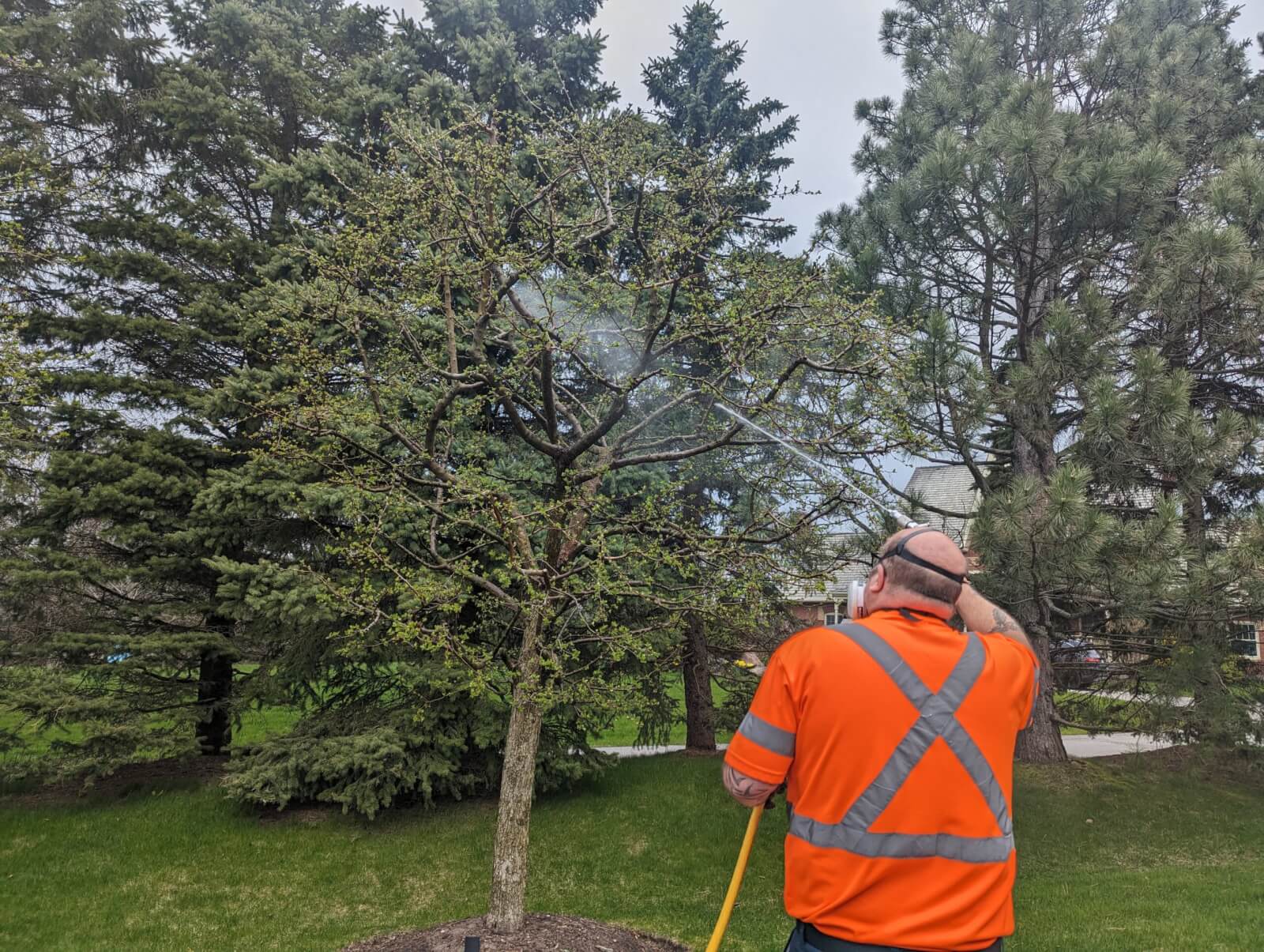
Standing upwind some distance away, I watched Dean work that first tree. He started with a few, short “test shots” into the ground to get the product to the pistol, and to adjust the width of the spray cone. Then a couple more test shots to the top of the tree to gauge the wind and the pressure. I watched him adjust the nozzle to a tighter stream and start circling the tree, spraying in short bursts until he was satisfied he’d achieved the coverage he was looking for.
Then he detached and drained the pistol before starting back to the truck. I asked what kind of coverage he was looking for and he said the standard was 90% of the canopy covered by at least 90%. That was startling to me given that our unofficial goal for most dilute applications in perennial tender fruit, pome, cane and berry is 100% of the canopy covered, but to a minimum threshold of ~15%. It’s likely due to the different chemistries (I noted earlier that urban applications tend towards biorational products). And, practically speaking, airblast sprayer operators cannot slowly circle a tree, aiming at trouble spots with an endless volume of water. Despite these differences, both methodologies seem to produce acceptable results.
The Label Dilemma
I’ve always been sympathetic of sprayer operators working in three-dimensional crops. Interpreting a North American label’s frustrating lack of guidance when it comes to water volumes for non-arable crops places a lot on the operator’s shoulders. I’ve discussed this disconnect (and proposed solutions) in several other articles. I’ve even co-written a book about it. The problem was particularly acute, here.
Ideally, one would evaluate the target tree’s planted area (which may or may not include an associated portion of alley) and work out the amount of formulated product required for that area. Then, that product must be dissolved or suspended in carrier (typically water) and that gives us the spray mix. Finally, working from the rate the sprayer emits, the operator would determine how much time would be needed to cover the target tree without over- or under-dosing. A good example of the process is found here.
But… how much water is the right amount? How do we reconcile having to achieve such a high degree of coverage? Does that mean using a more dilute spray mix depending on the canopy, or the chemistry, or the method of application? And what happens when the target canopy size can be variable by an order of magnitude, such as going from a small, sparse tree to a huge, full tree? Would the operator have to change concentrations for every job in order to have the right combination of water volume and chemistry to propel and deposit the product uniformly?
There’s no easy answer. Yet I watched Dean deal with this problem at every job, working to keep as much spray on target and use only as much spray mix as required to meet his coverage threshold.
Administration and Cleanup
Back at the truck Dean shut off the pump and reeled in the hose through a hand-held rag to ensure the hose came back cleaned of anything it may have been dragged through. Overall, it took six minutes to complete the spray job, but then the clients came out to speak to Dean and that conversation lasted another 10. Client interaction / education is a big part of this job.
By 8:10 Dean had posted a Notice of Service sign in the yard (which must stay there for 48 hours) and punched in the next address on the GPS. As we headed off, he said a big improvement in recent years is the ability to email a Notice of Service and send an invoice right from the client’s driveway, immediately following the service. What traditionally was a 1-2 week wait for payment is now less than a day. If requested, Dean could also write them out manually and leave them at the client’s door.
8:25
The next client had five weeping crab apples. These were low trees easily accessed by the roadside truck. Wind was light so low pressure was required. Dean noted that he takes the pressure off the pump between stops to relax the drive belt. He double checked that the pistol was empty and said the reason he drains it after each job was to prevent any possibility of puddles in the truck, on the road or in the client’s driveway. “Customers should never see puddles. It’s better for the environment and it’s professionalism.”
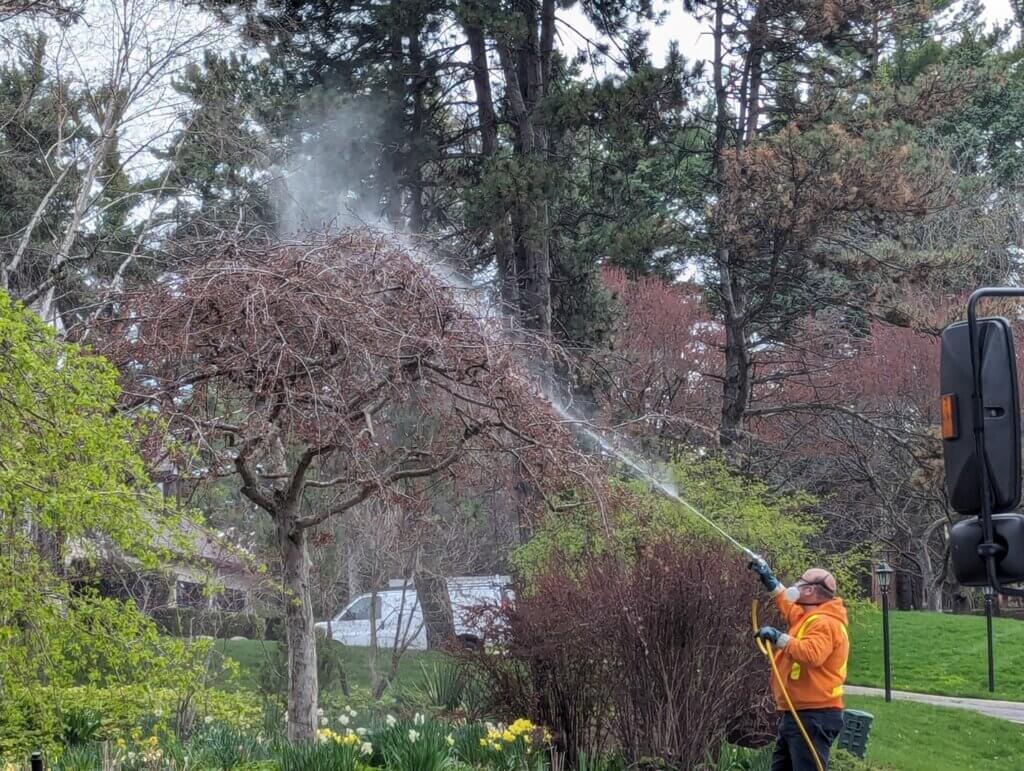
There’s a lot of wash, rinse, repeat from here on, so I’ll only note anything unique to each spray job. In this case, I watched more closely to understand how Dean aimed. A stream of liquid can traverse a great distance without being deflected by wind, but it’s not the cloud of droplets we generally associate with spraying. I realized Dean was shattering that stream of liquid on the larger branches to create the droplets. That’s also why he occasional pulsed the spray by fluttering the trigger; Sometimes the distance warranted a longer throw (long stream shattering of a branch) and sometimes a series of short pulses (shorter throw and the spray broke up on its own). I watched him as he circled each tree, changing his vantage as required. It wasn’t as easy as he made it look, and he was fast.
9:05
This was a single, 20-foot high crab apple tree. Dean cranked it up to 225 psi and started with the pistol. Given the height, the wind was more of an issue, so he waited for lulls, using short pulses over short distances and holding the stream for longer distances. He widened the nozzle only when the wind was light and the target was particularly close, but eventually switched to the long gun to reach the treetop.
10:10
This time we were spraying a Magnolia tree. Dean inspected the flowers closely. This tree might bloom for 5-8 days and if the flowers are too open, the oil we would use in the treatment might damage them in high UV. Plus, the mechanical damage from the spray might knock them off. But the flowers were still closed enough for the preventative to be applied.
You may have noticed that in this case we weren’t using the fungicide, but instead we’d protect the tree from scale using an oil. So how (I wondered) do we empty the pump and 300 feet of hose of fungicide and exchange it for horticultural oil? Thanks to there being no physical or chemical incompatibility with these two products, it turned not to be the “big deal” it would be for most other spray operations.
Dean opened the draw valve for the oil and kept the return valve open on the fungicide tank. Then he started the pump and hopped up on the truck to spray the fungicide right back into the fungicide tank. When he saw the spray turn opaque, he knew he had primed the oil and stopped spraying. Then he shut off the return on the fungicide tank and opened the return on the horticultural oil tank. The swap took almost no time at all and the subsequent treatment was a breeze.
10:52
Stop five was in Snowball Corners in King City and Dean was a little surprised that the work order underestimated the job. We expected a couple crab apples but instead found 20 trees far into a large backyard. Dean took some time with this new client to explain the process, then we fed all 300’ of hose out to reach the trees. We hoped there was enough in the tanks to finish the day!
Winds were high, but there was nothing around and Dean used short bursts and a tight stream shattered on the trees themselves to reduce the number of driftable fines that would be produced by a wide spray. Slowly, picking his moments, he worked in the up-to-downwind direction so any overspray hit the next target.
11:37
One small Crabapple.
12:00
Nine ornamental apples.
Interfacing with the Public
I used to think that operations like vineyards and orchards, which often suffer the dreaded urban-rural interface, had the hardest time explaining crop protection to the public. And that’s not just agritourism operations with farmgate sales, either. Throughout the day, however, I elevated arborists to the top of the heap. Case in point:
Before the trucks left that the yard that morning, one of the operators asked Dean about a job in downtown Toronto for a major business on Bloor Avenue. The client did not want applications performed after 8:00 am because hoses on sidewalks are a tripping hazard. They were also restricted from spraying at night because of city noise bylaws (those pumps can be loud).
Accessing the plants can be very difficult and working in downtown Toronto can be exceptionally challenging. Dean knew the spot by rote, saying they should “Come from the street, look to 1 o’clock and 15 m from the statue to find the boxwoods. Then pace the distance to ensure the 300 foot hose would reach. If not, transfer the chemistry to bottle spray. If so, bring the operating pressure up to compensate for the distance.”
Dean explained that the crew-leader of each truck makes the call for the most effective and safest set-up. He went on to relate stories about angry neighbours that responded poorly to seeing staff in PPE, or the grief they would suffer when a flower bed or stone path was marred by the hose. He reiterated throughout the day how much of his job was explaining the spray application process to clients, their neighbours and anyone (read everyone) that might be watching.
Dean said there would always be a way forward if you gave it some thought. “Work the problem. Don’t let the problem work you.”
12:33
One backyard crabapple.
1:10
Two crab apples in the backyard. This was the last stop and it was perhaps the most complicated. One nearby tree was vibrating with honeybees. The wind was blowing into the neighbour’s yard and the two tall trees were on the property line. Dean really took his time here, rapidly pulsing the pistol whenever the wind died down and directed away from the pollinators. Some overspray moved to the next yard, but it couldn’t be helped. At least it was minimized. All in all we were pleased at the accuracy.
Then the clients, who were new, came home and Dean once again spent time with them explaining the process. We got back in the truck after posting the sign and as Dean emailed the Notice of Service and the invoice, the first few drops of rain started to hit our windshield. All that patience and effort on the last stop and the client would likely need a re-application the next day. Dean was unflappable: “You can’t control the weather.”
Epilogue
We grabbed a late lunch and Dean drove us back to the yard. I’d learned a lot and really enjoyed Dean’s company. He headed back into the office to see how the day went for the other operators and plan for tomorrow. As for me, it had been a long day and I was loathing the punishing drive ahead of me… so I sprang for the 407 toll highway.
Take Homes
Upon reflection, and having written this article over about two weeks, I think I’ll end each article with a few observations. Bear in mind that I do so based on a sample size of one. That means what I did and what I saw may be unique; It should not be taken to represent an industry, a company, or even the typical practices of a single operator given that we only spent one day together.
Generally, label direction does not adequately inform sprayer operators working in three-dimensional crops. I have noted this in fruit protection systems and greenhouse systems, but it may be particularly relevant for arborists.
The classic urban-rural interface can cause friction between agricultural production and surrounding residential areas. Not only as a function of pesticide drift, but also noise, dust, odour, etc. Arborists work in urban environments, are scrutinized constantly and are quite often misunderstood by well-meaning people. As such, their job is far more than product application – they spend a considerable amount of time educating and answering questions, making them front-line ambassadors for crop protection processes.
The concept of threshold spray coverage (or minimal effective dose) continues to be a difficult and elusive thing. Factors such as mode of action, the nature of the target (surface structure and location), environmental conditions, application equipment and spray quality/concentration are already tricky to say the least. Having watched the relatively dilute, saturating, and highly mechanical applications performed by an arborist I continue to reassess what I think of as “good coverage”.
We sprayed 42 trees in roughly seven hours. Productivity, refill time, travel time and the economic considerations common to all spraying have different standards in each agricultural space. Efficiency is, obviously, important to any operation, but this experience reinforced just how different each operation can be. An orchardist may grumble about having to drive between blocks using county roads but imagine doing that on the 404! It’s all relative.
I feel it’s important to occasionally remind myself why I do what I do, and who I’m doing it for. With that, let me tell you a story.
I was recently asked to give a presentation about spray coverage and drift mitigation to an arborist organization. I agreed but harboured reservations. I’ve given talks of this nature many, many times, but I rarely work with arborists. In preparation I looked back through my files and discovered I’d spoken to them 10 years ago. Coincidently, that was also the last time I’d encountered an arborist.
So, what value could I possibly offer? My concern was that all I’d leave them with was a few “factoids” and the vague sense that they’d been entertained. But would I leave things better than I found them? What could I say that would move the needle and give them something actionable?
Fortunately, I was paired with a veteran sprayer operator and together we worked out a presentation / demonstration. It went over very well, and I was relieved that people were engaged and asked insightful questions. Crisis averted.
I believe the reason it worked was because I asked the operator about the real-world challenges (however unpopular) that he faced. We discussed and agreed upon a few lesser-of-two-evils solutions to share with the group. It was authentic, it was pragmatic, and it was appreciated.
As a result, I decided to dedicate some time this spring/summer to riding along with a variety of sprayer operators as they perform their jobs. If they’d have me, I’d promise to stay out of their hair, acting only as an observer. I wouldn’t make suggestions and I wouldn’t criticize. I would ask the occasional question and I’d watch to see where policy and reality crossed paths.
I was hoping for a few educational experiences that would inform my research trajectory and teach me a few tips and tricks to share at winter meetings. Perhaps I’d reinforce my understanding of spray application, or maybe I’d be forced to re-evaluate my position on what is a technical truth and what is a practical truth. At the very least I would get to see how professionals did their jobs, and which best practices got sacrificed when things didn’t go to plan.
And, while I was at it, I decided to keep a journal to create articles in the vein of “A Day in the Life”. You’re reading the first one right now and I hope you find it as interesting to read about as I did to live it. It’s unlikely you work in all the agricultural spaces I’ll be writing about in this series but keep an open mind. The potential for cross-pollination is enormous; Perhaps your “cousin” sprayer operator has solved a problem you face in your own operation.
And so, given our recent success, my first victim will be my new arborist-friend. You can read all about it here.
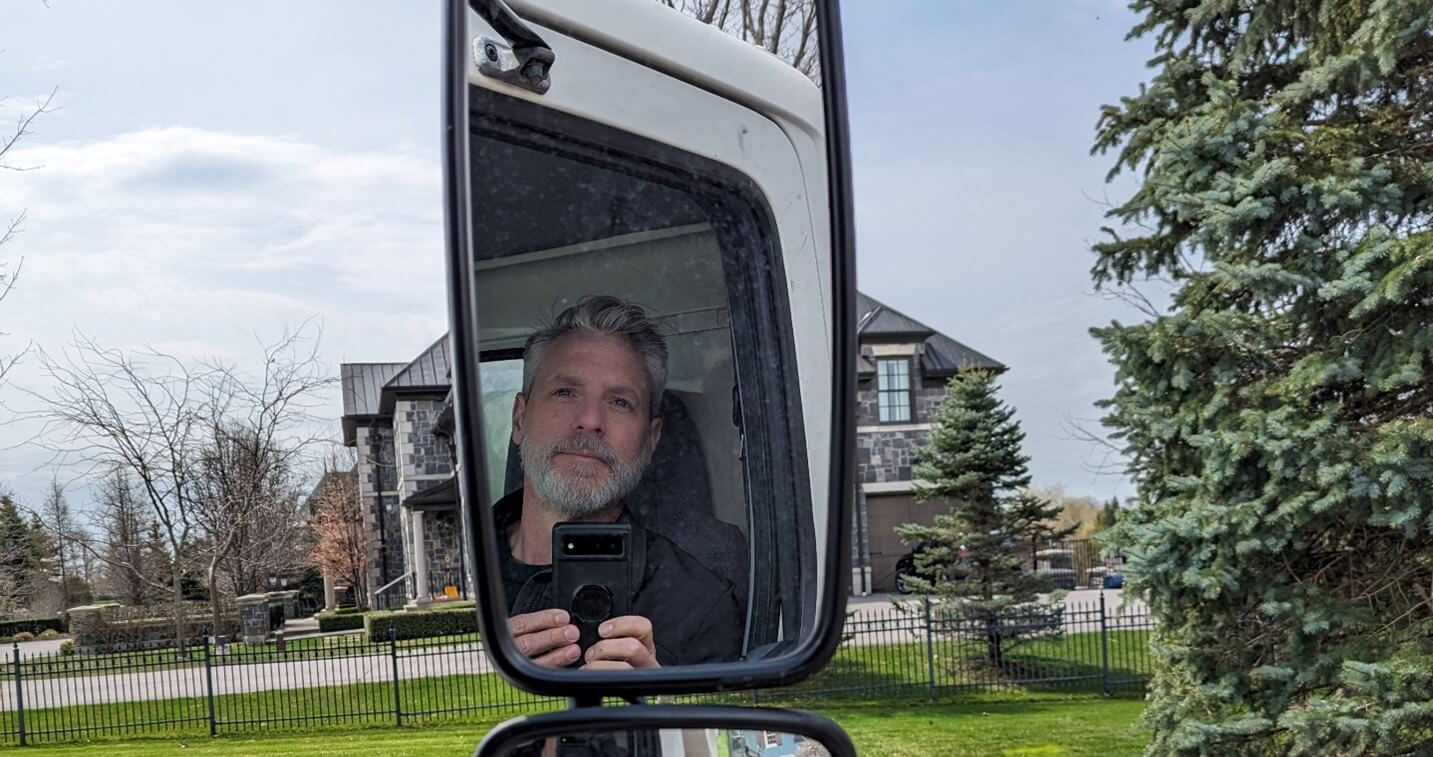
A quick selfie in suburbia as I’m guided through a day in the life of an arborist.
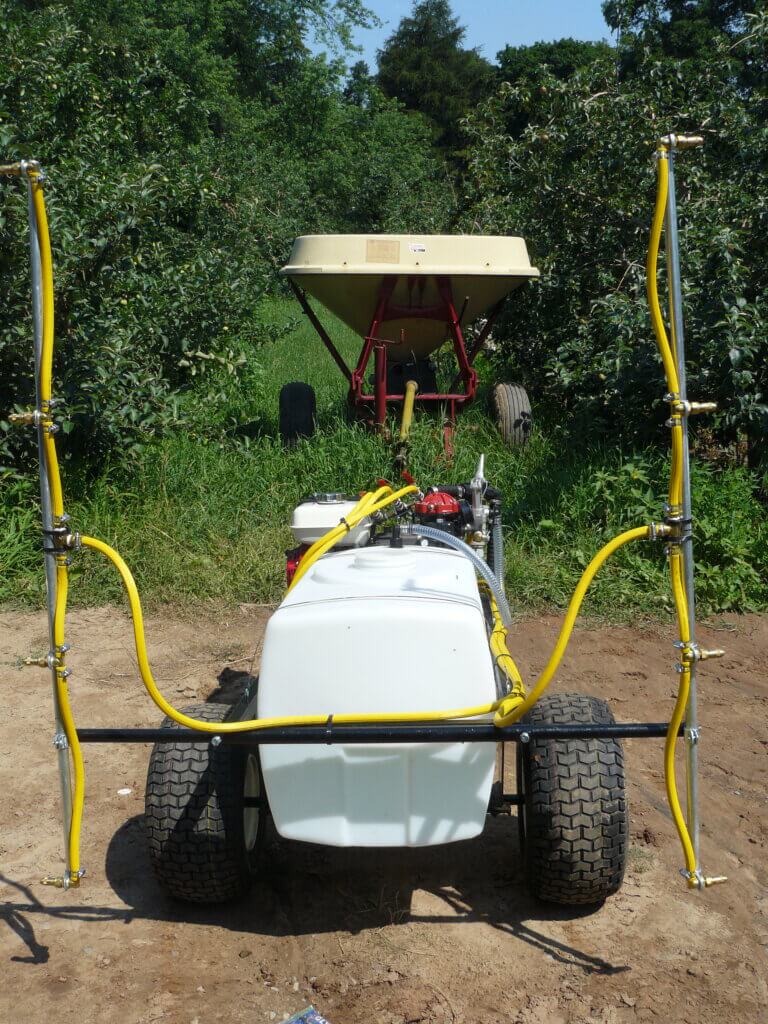
Did you come here looking for advice on which sprayer is best for your small operation? Are you looking to ditch the backpack mist blower? Do you want to avoid repeatedly mounting and dismounting a 3-pt hitch sprayer from your only tractor? Are you concerned you’ll have to sell an organ to be able to afford one? We hear you, and we’ll try to help. Let’s set the stage with a few facts.
Airblast sprayers stay in service for a long time; more than twenty five years is not unheard of. The majority of them are the generalist, PTO-driven low profile radial design with capacities ranging 150 to 1,200 gallons. Typical fan diameters are around 30″ and can produce >40,000 m3/h of air, making them a good fit for most pomme, citrus and tender fruit canopies. These sprayers come with a horsepower price tag of perhaps 45 hp or more. Many of these sprayers eventually enter the used sprayer market, making them an affordable option for small acreage specialty operations. But, affordability should not be the sole motivation when choosing a sprayer.
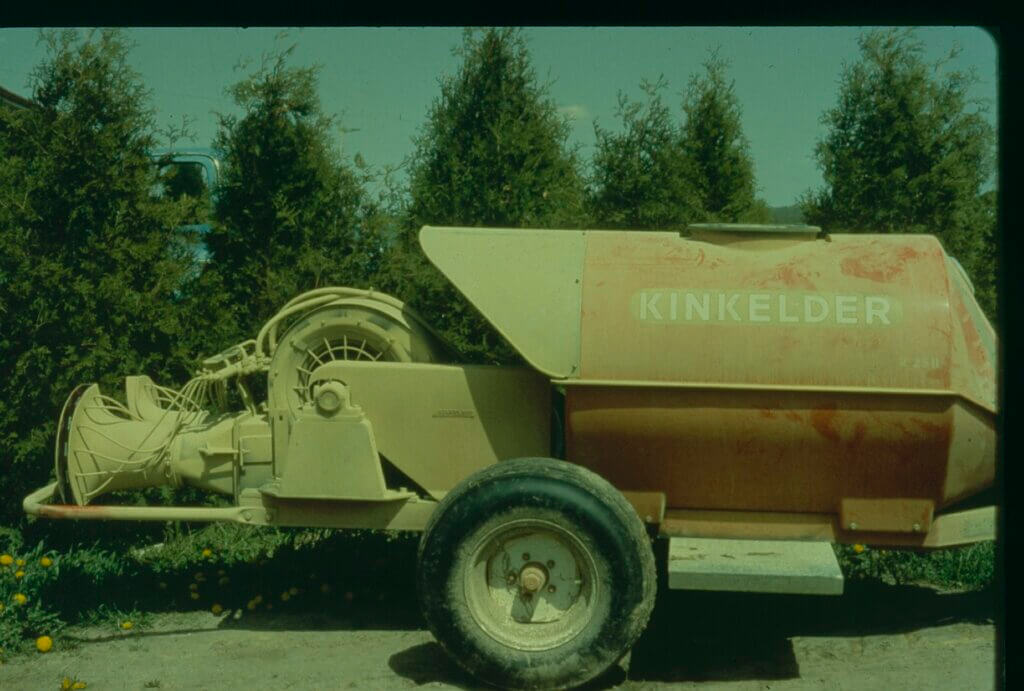
Ontario, c.1980 and probably still out there spraying somewhere!
The key to optimizing sprayer performance is to match the air settings to the the canopy you’re trying to spray. You can start reading about the process here. In the case of small and medium-sized canopies like vine, cane and bush crops, the fleet of gently-used sprayers we just described tend to produce too much air. There are options to improve the fit, like driving faster to reduce dwell time, or perhaps the operator can employ the Gear-up Throttle-down method. But, the best plan is to employ a smaller sprayer, which produces a more appropriate air volume, has a smaller profile, delivers better fuel efficiency and won’t break the bank.
So, where are these sprayers? Unfortunately there aren’t many, and options are especially limited if you don’t own a tractor to power them.
The budget-conscious grower may be tempted to buy a sprayer that does not have air-assist. We do not recommend this. Air is a critical component for spraying canopies consistently and efficiently. Caveat Emptor!
We encountered a good solution in June, 2014, when we were invited to Durocher Farm in New Hampshire to see their new airblast sprayer. In years previous, spotted-wing drosophila (SWD) was a significant pest in this two acre, high bush blueberry planting. They claimed that since buying their new sprayer they no longer had any trouble with SWD. That’s quite an endorsement!
The Carrarospray ATVM (200 L option pictured)
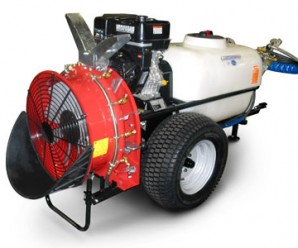
I’m not sure what I expected, but I was captivated by this miniature orchard sprayer. The toy-like size carried a zero-intimidation factor and I immediately wanted to start using it. Italian-made, Carrarospray’s hobby line is designed to be pulled behind vehicles without PTO. The ATVM is available in capacities from 120-400 L. The one I saw had a 400 L capacity, adjustable air deflectors, a fan speed gear box, and it was powered by a quiet and efficient pull-start Briggs & Stratton four-stroke engine. It even had a trash guard, a kick-stand and a clean water tank for hand washing. That’s a lot of features.
Thanks to Kitt Plummer (Durocher Farm), Penn State, Univ. New Hampshire and Chazzbo Media for filming these 2014 videos:
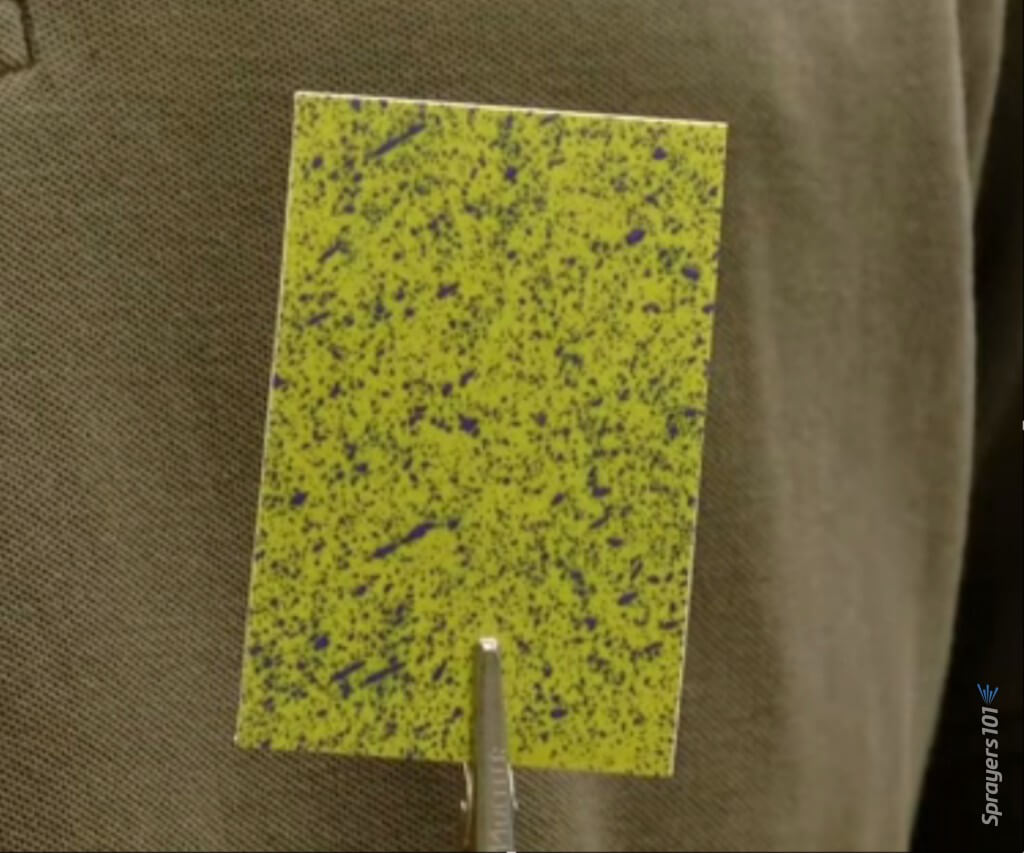
The sprayer was pulled (in this case) by a mower, so the grower not only sprayed, but mowed his alleys at the same time. It fit beautifully between the bushes, so the potential for physical damage to the berries was minimized. The air speed and volume was enough to displace the air in the blueberry canopy and replace it with spray-laden air with minimal blow-through. Combined with an appropriate spray volume and distribution over the boom, we found that the coverage it provided was excellent.
Coverage from the top-centre of the bush.
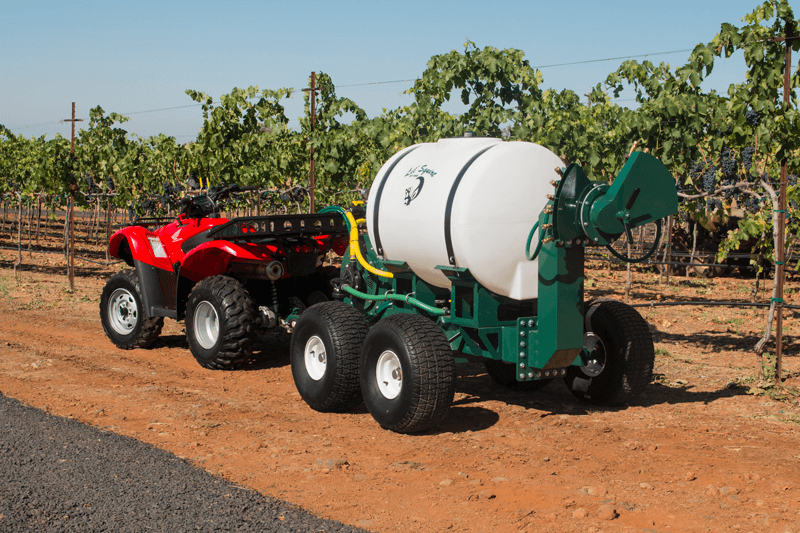
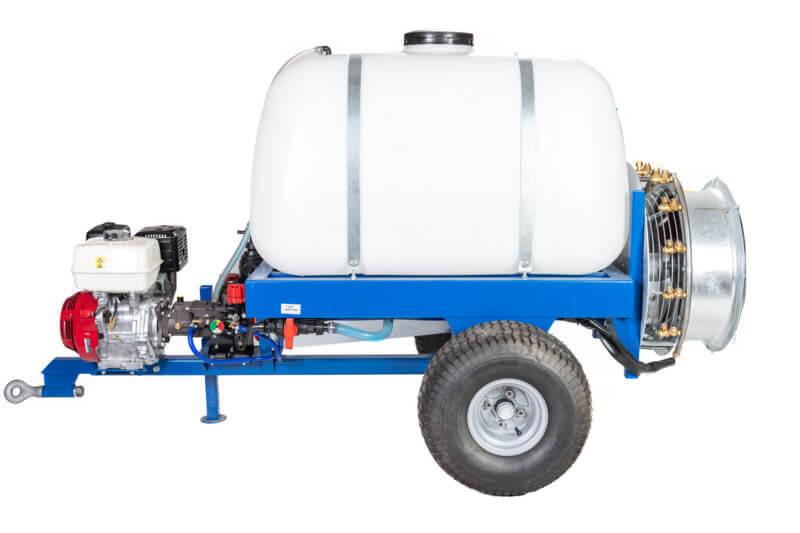
Since seeing this sprayer, we have had reports that importing it to Canada has proved challenging. But there are alternatives. A few companies here in North America offer economy-sized airblast models that are ATV trailed, or skid-mounted, or attached to a small tractor via a three point hitch. PBM’s Lil Squirt is a simple and versatile option. Available primarily in the western US from California through to Washington.
PBM’s trailed Lil Squirt (Image from their website)
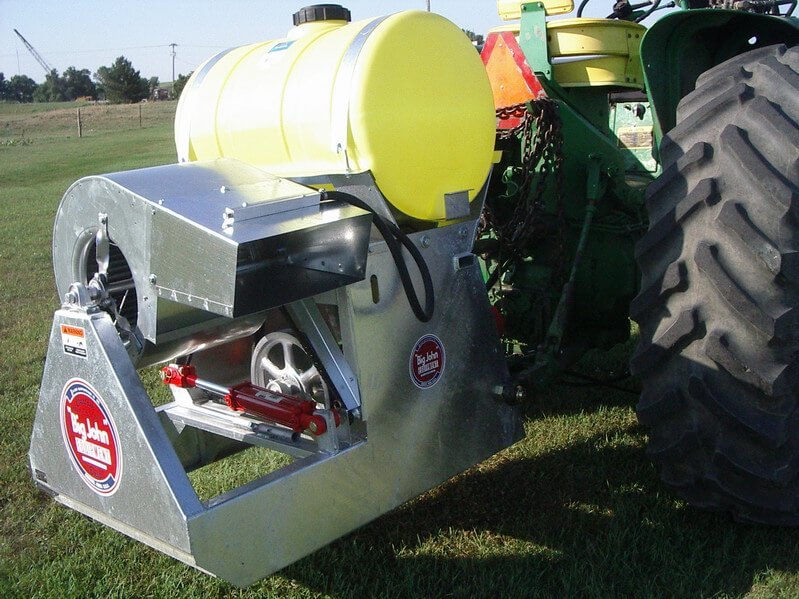
Another option is the mounted, PTO-driven mistblower line from Big John Manufacturing in Nebraska.
BJ 3PT mistblower from Big John Manufacturing (Image from their website)
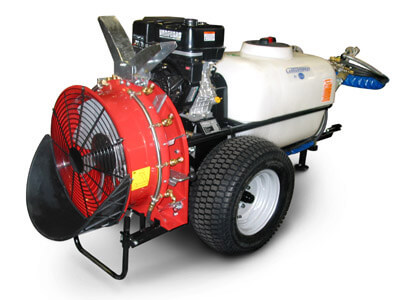
Or MM Sprayer‘s ATV sprayers, which come PTO or Engine-driven. The LG400 has a 106 gallon tank and a 20″ fan. I’d like to see deflectors, but you could easily add them. Here’s a 2024 pdf on features.
Picture of the LG400 engine-driven model from www.mmsprayers.usa
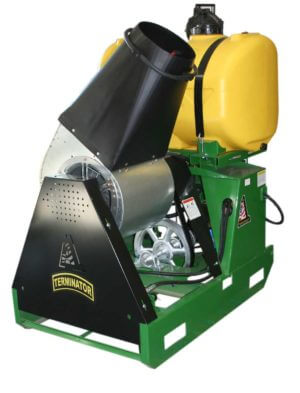
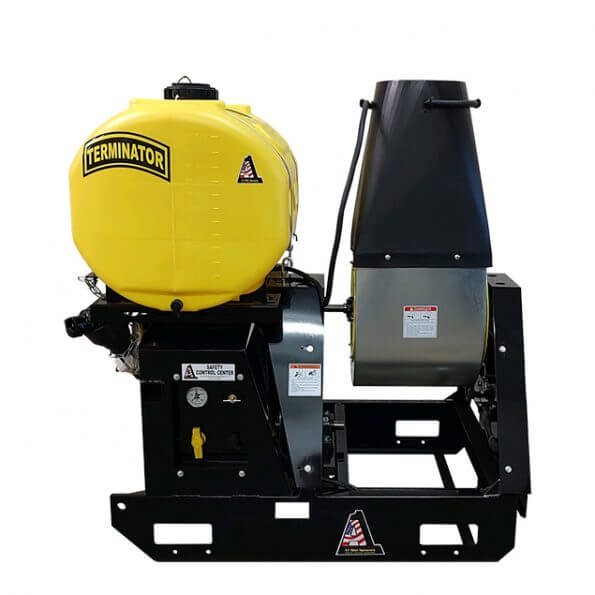
Or Wisconsin’s Contree Sprayer and Equipment. They carry the “Terminator” line. Skid mounted, one-sided air shear units with capacities from 15 to 100 gallons, this company offers a range of possibilities both PTO and gas-driven. Well worth a look.
The “Terminator” skid-mounted mist blower from Contree Sprayer and Equipment (Image from their website)
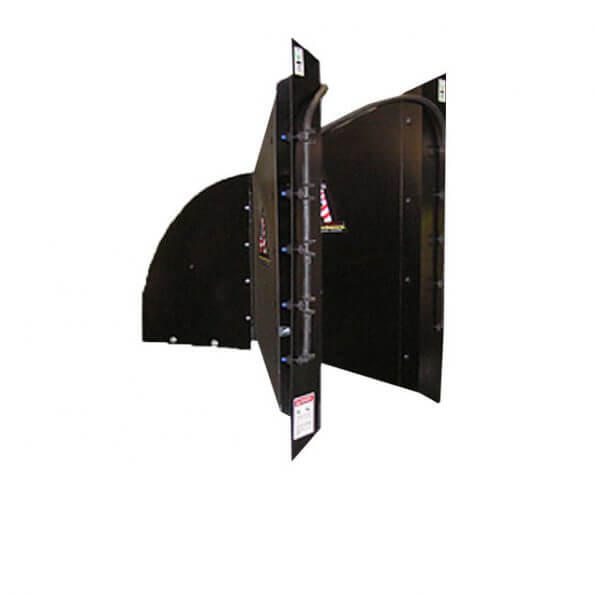
Then there’s the A1 Mist sprayer series, also out of Nebraska. They carry the Terminator line as well as an interesting two-sided volute option that employs conventional nozzles and allows one pass down an alley rather than two. This is a big productivity booster:
A1’s two-way volute header. (Image from website)A1’s PTO-driven 60 gallon, skid-mounted “Terminator”. (Image from website).
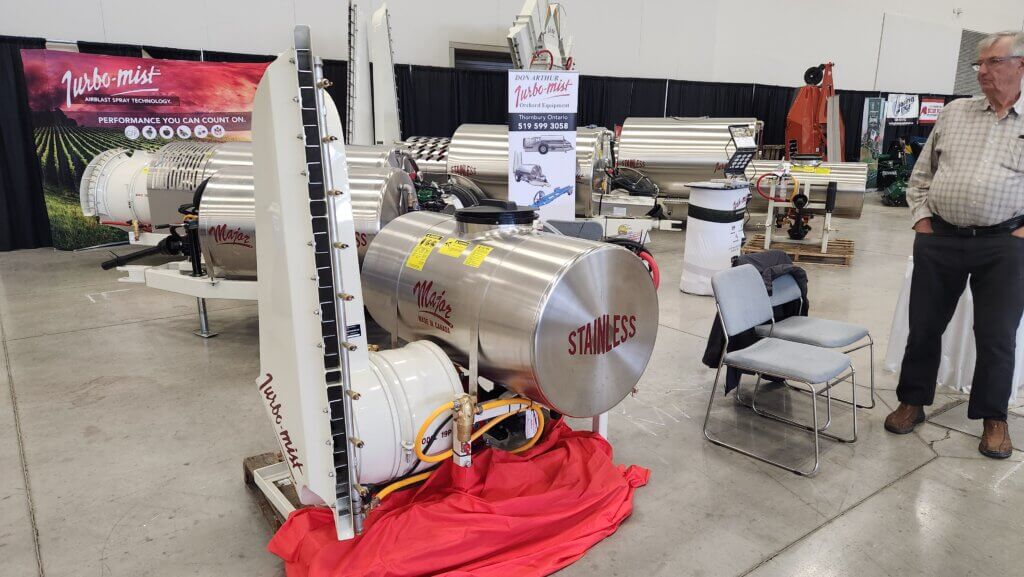
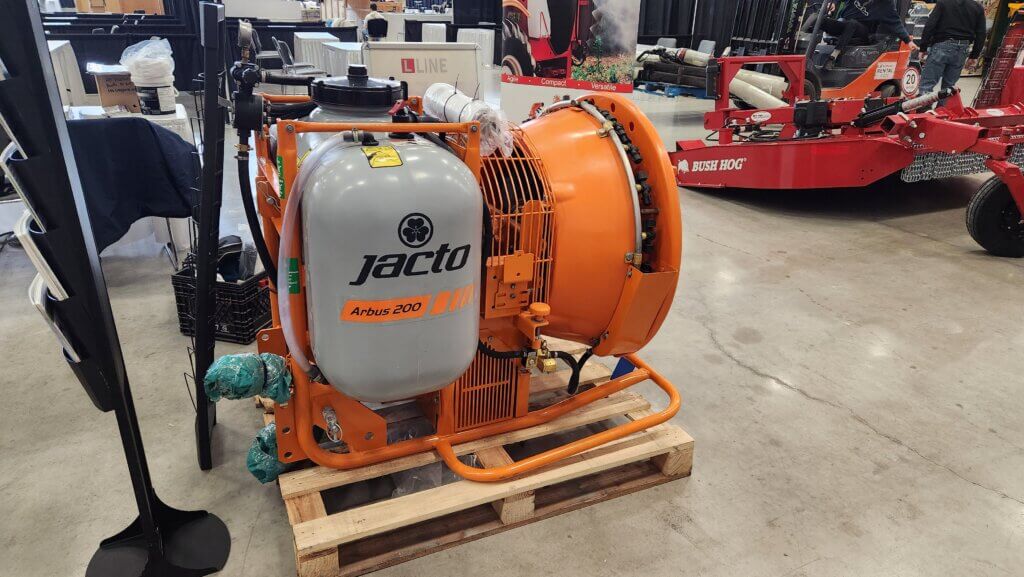
Then there are larger, PTO-driven, three-point hitch options. In fact, there are many options for this manner of sprayer, but they tend to be out of the price range for small operations, and they do require a tractor. That isn’t a deal-breaker, though, as they can sometimes be found used. Pictured below is British Columbia’s Major 193 (Slimline Manufacturing) and a Brazilian-made option (Jacto) distributed out of Quebec.
Slimline Manufacturing (aka Turbomist) makes the Major 19P 3-pt hitch tower sprayer (PTO-driven)Jacto’s Arbus 200 3-pt hitch airblast sprayer (PTO-driven)
When considering your options, give serious thought to your work rate, refill time and other factors that go into developing a robust spraying strategy. What’s a spraying strategy? That’s a farm’s overall management and operational plan for achieving safe, effective and efficient spray coverage. You can read more in chapter 8 of Airblast101, which you can download for free, here. And, just to play Devil’s Advocate, go small but not so small that the sprayer is underpowered.
We staged this video in 2011 (spraying only water, so don’t mind the lack of PPE) to show how a sprayer can be too small for an operation. This 3-pt hitch GB cannot overcome the cross wind and the spray barely reaches the apple trees. Reducing travel speed and increasing pressure won’t cut it, either.
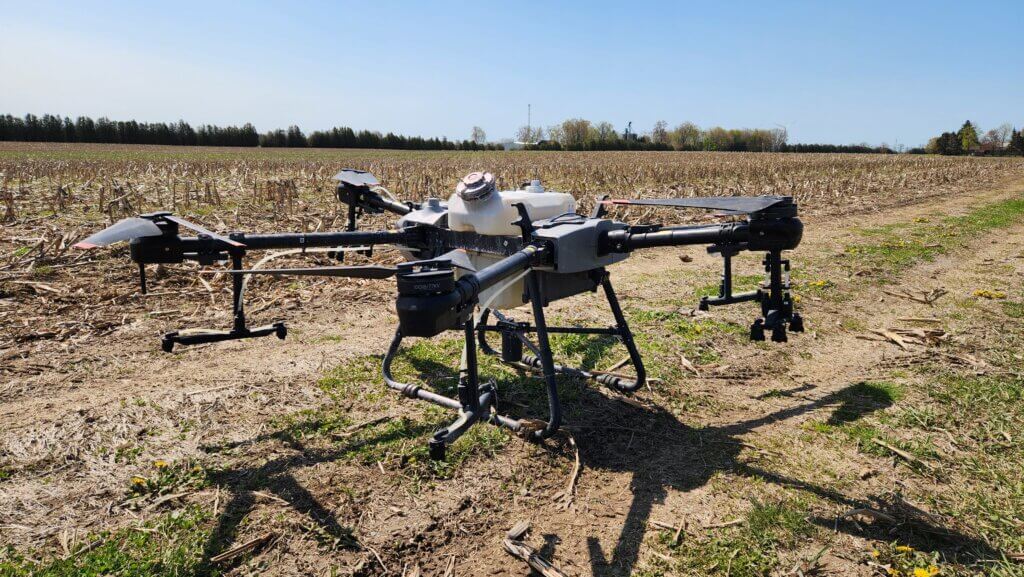
Of course, other possibilities are emerging for crop protection in small acreage perennial crops. Multirotor drones are capable of delivering air-assisted spray from above the canopy. While it’s still a drift-prone and inconsistent means for broadcast spraying, it might lend itself to perennial row crops. Equipment design is evolving quickly and global research is underway to establish best practices. As regulators and agrichemical companies focus more on this method we may see drones as a cheap alternative to a tractor/airblast sprayer, with no compaction, no mechanical damage to fruit/berries, and no potential for splashing infection throughout an operations.
DJI’s Agras T30
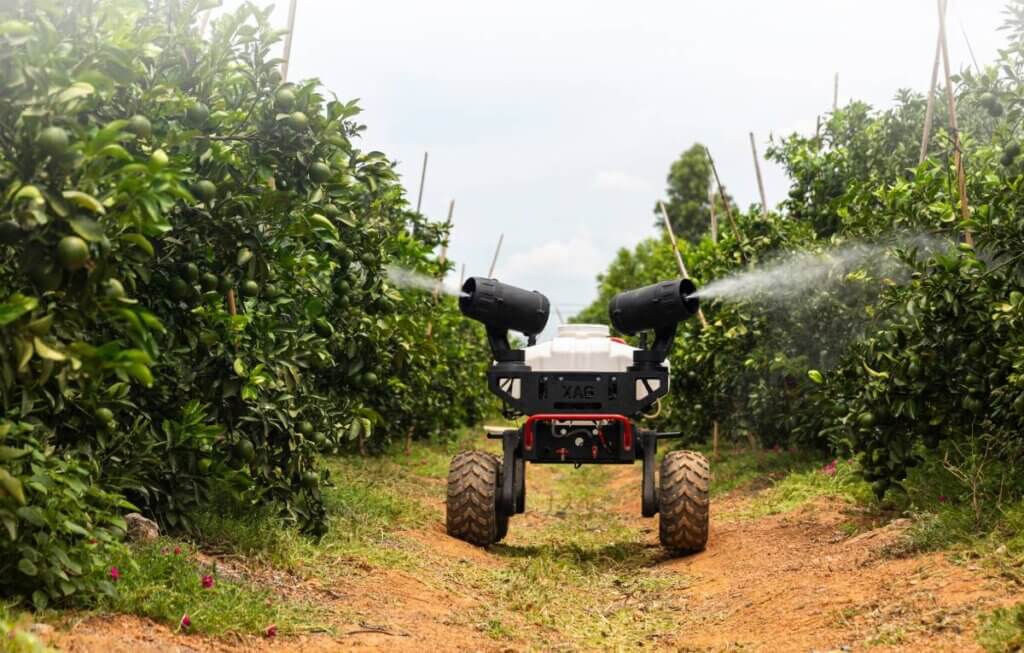
Even further into the future, small autonomous sprayers may be viable, too. Very much in their early days there is great potential. One example is the XAG Revospray Ground 2 with it’s 150L capacity or the R150 with it’s 100 L capacity.
The R150 – Image from https://hse-uav.com/. Modular system and ~32K USD (as of 2023)… if you can find one.
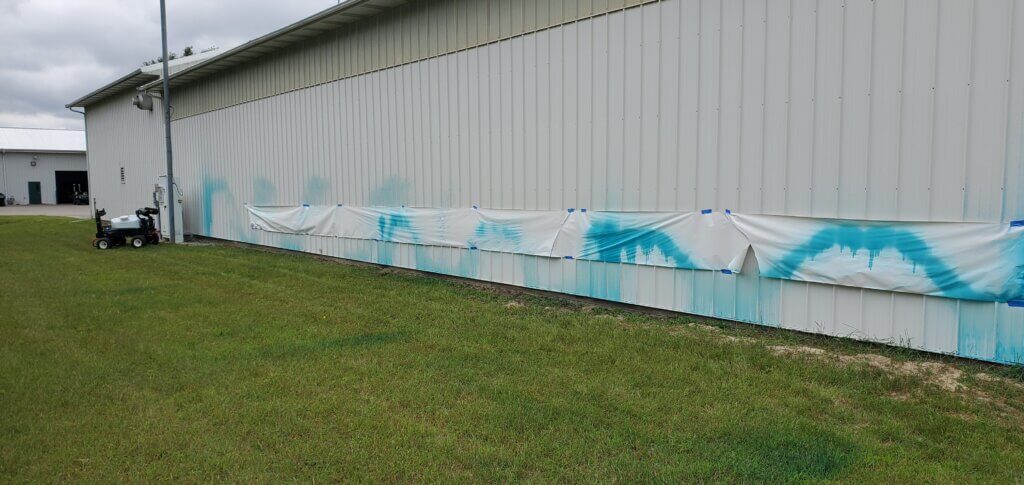
It’s early days, but there are researchers looking at the spray pattern from these units. The image below may not be a fair indication because the nozzle used may not have produced as wide a swath as possible. Thanks to Dr. M. Reinke for the image.
A test pass using food grade dye. You can see the waveform created by the two spray heads as they move up and down during travel.
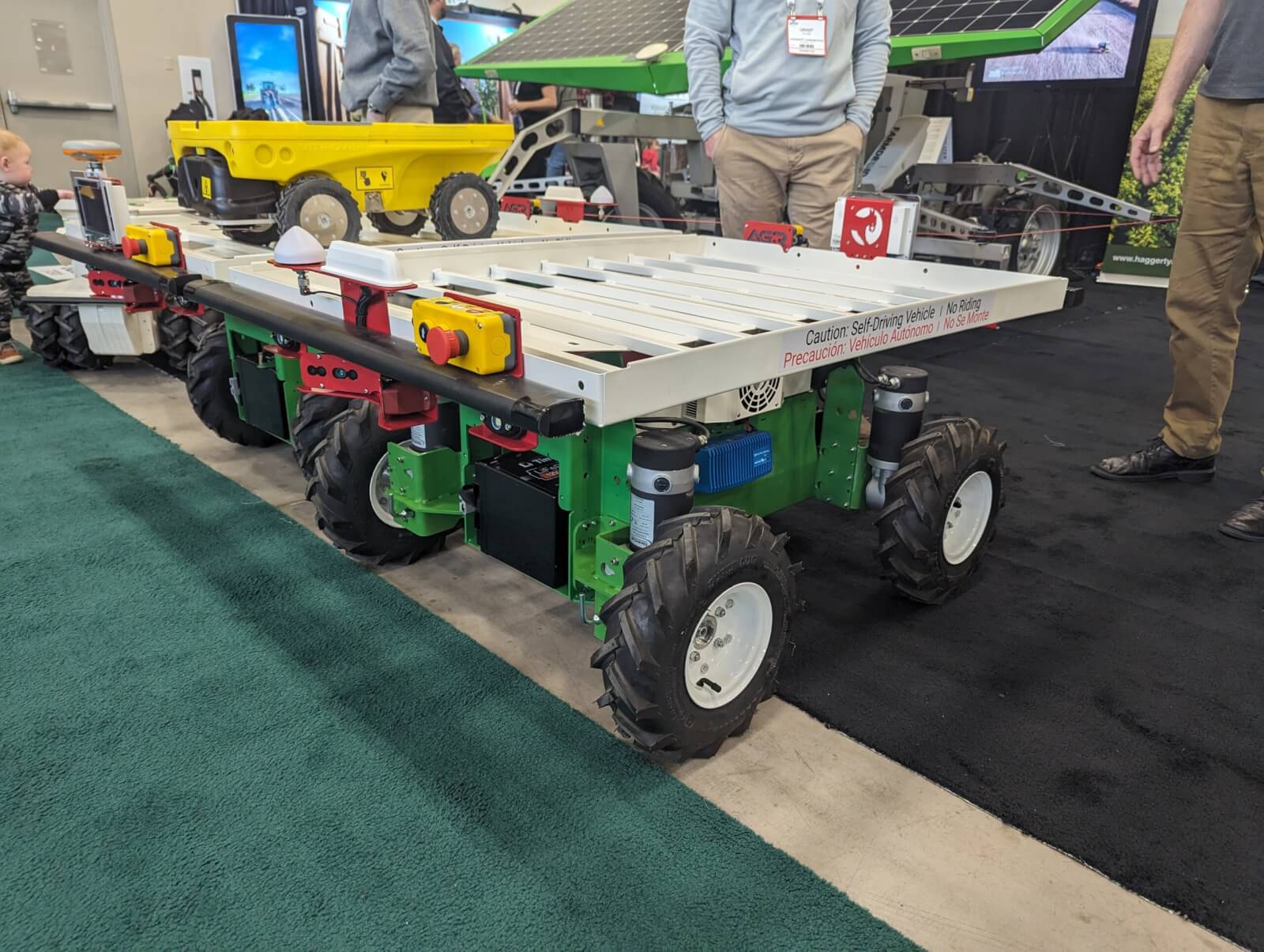
And recently, small autonomous platforms have become more common. Perhaps there’s an opportunity to place a gas powered sprayer on these platforms, or use them to pull a hitch-style sprayer. One such possibility is created by the Burro, shown below at the Ontario Fruit and Vegetable Convention in 2024.