Category: Speciality Sprayers

Main category for all sprayers that are not horizontal booms

  • Airblast Agitation and Solubags

    Airblast Agitation and Solubags

    Agricultural products are formulated to be as emulsifiable as possible, but many do not mix well in water. They contain elements that do not dissolve (e.g. wettable powders), or they may be petroleum distillates (e.g. emulsifiable concentrates). Other products are heavier than water and form precipitates (e.g. fertilizers and powdered metals like copper). Consequently, good agitation is very important.

    Effective agitation requires water to “sweep” the bottom of the tank so that any precipitated material is picked up and re-mixed. Turbulence is often not enough. If there is too little agitation, the pesticide will be applied unevenly and not always at the required rate. If there is too much agitation, the pesticide may foam (which can be controlled using anti-foamers) or cause an invert emulsion (a gel). There are two types of airblast sprayer agitation: Mechanical and Hydraulic (learn about pros and cons here).

    Mechanical Agitation

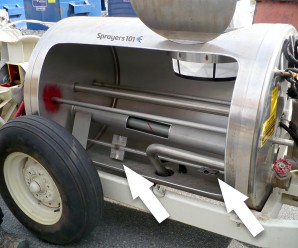
    Mechanical Agitation is produced by paddles that are attached to a shaft mounted near the bottom of the spray tank. While effective, this system cannot always sweep the very bottom of the tank, so there is always some material that precipitates out of reach. Are your nozzles and screens plugging frequently, and is there “sludge” left at the bottom of the tank after spraying? You may have an agitation issue.

    Note the two paddles set at 90° to one another on the mechanical agitation shaft in this very cool “cutaway” Turbomist sprayer.
    Note the two paddles set at 90° to one another on the mechanical agitation shaft in this very cool “cutaway” Turbomist sprayer.

    Hydraulic Agitation

    Hydraulic Agitation is accomplished by returning a portion of the pump output to the tank. Cylindrical and oval tanks are the ideal configuration for the sparging (i.e. rinsing) type of hydraulic return agitation system. This system consists of a tube located longitudinally along the wall of the tank, with volume booster nozzles aimed at the centreline so they sweep across the bottom. Volume booster nozzles take a small amount of water pumped into their venturi chamber and create a vacuum that draws three to four times that volume from the surrounding water and expels it out the end.

    For hydraulic agitation to the effective, the agitator nozzle(s) should be fed by a dedicated line from the pressure side of the pump (not the pressure regulator). They should have a valve to throttle the flow or completely shut it off to prevent foaming.

    A mixing nozzle in the basket of a Hol sprayer.
    A mixing nozzle in the basket of a Hol sprayer.
    With enough pump capacity, a hydraulic return in the tank basket is a great way to agitate as you mix. A return in an old FMC.
    With enough pump capacity, a hydraulic return in the tank basket is a great way to agitate as you mix. A return in an older FMC.

    Adding Water Soluble Pouches

    Adding pesticide to the sprayer may not always be straight-forward. Many airblast operators, for example, place dissolvable pouches in the basket so they can be broken up by the hydraulic return, or the fill water. But fill water often splatters out of the basket, and the bags can burst open, releasing product into the air. This creates unnecessary contamination and both inhalation and dermal exposure concerns.
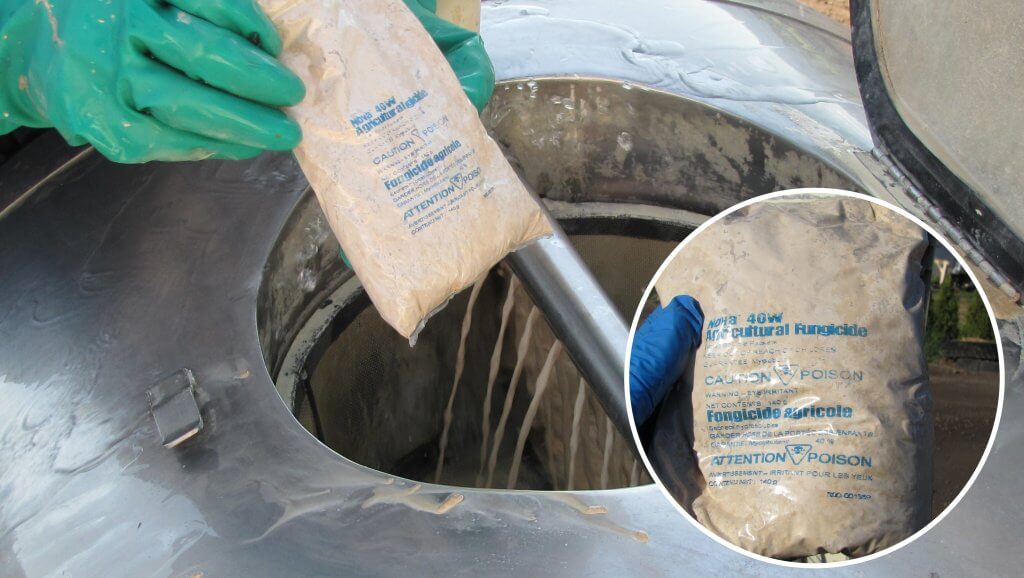
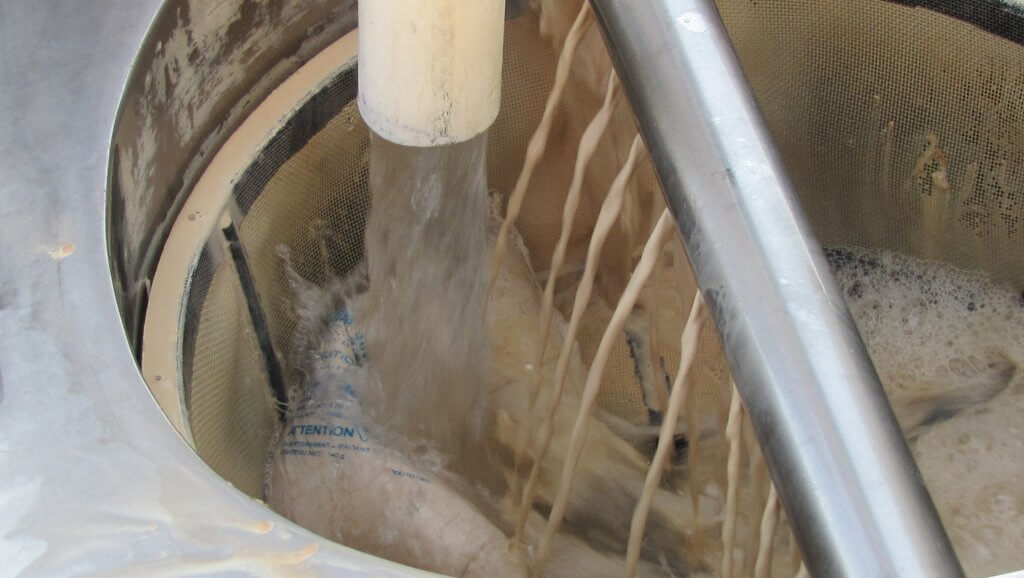
    Photo credit: Mario Lanthier.
    Photo credit: Mario Lanthier.

    Some elect to temporarily remove the basket and add the pouches to a half-full tank with the agitator on. However, the pump can suck in the partially dissolved bag which then coats the intake screen. This is exacerbated when the fill water is cold. I know of one operator that had to rebuild the pump because the Viton seals burned out. This operator now adds pouches to the basket while standing upwind and away from potential splatter. Or, they mix a pre-slurry.

    Mixing a pre-slurry requires the operator cut the bag into a five or 10 gallon bucket filled with water and to incorporate using a paint mixer. However, mixing a pre-slurry increases the chances of dermal exposure, inhalation and point-source contamination. Dissolvable bags were intended as a form of closed transfer, which is a good idea. Mixing a pre-slurry defeats that intent.

    And so, for all these reason, I don’t feel dissolvable pouches are a good formulation choice. If possible, select product formulations that do not cause possible filling issues and better match the capabilities of your agitation system. Always choose the safest and most effective filling method for your sprayer design.


  • Exploding Sprayer Myths (ep.4): Speed Spraying

    Exploding Sprayer Myths (ep.4): Speed Spraying

    All set for Star Wars VII
    All set for Star Wars VII

    With due respect to Mickey and Mr. Lucas, and the massive hype surrounding Star Wars Episode VII, we felt we should jump on the bandwagon. Here’s episode IV in our series of short, educational and irreverent videos made with Real Agriculture.

    If there’s a single take-home message in this episode it’s this:

    …may the force be with you – always.

  • Exploding Sprayer Myths (ep.12): The Buffer Zone

    Exploding Sprayer Myths (ep.12): The Buffer Zone

    In this episode of Exploding Sprayer Myths we reduce a complicated best practice to black and white… literally. Watch as Jason and Tom get a creepy lesson in the do’s and do not’s of no-spray areas. Under the watchful eye of Dr. Jim Todd (OMAFRA Industrial Crops Specialist and Rod Serling cos-player), brace yourself as you enter The Buffer Zone.

    Learn more about how vegetative filter strips mitigate runoff on this Health Canada webpage.

    Thanks to the staff at the Simcoe Resource Station and to RealAgriculture for making this video possible.

    And if you’re curious about the kitchen-appliance cameo, you’ll have refer back to earlier episodes.

  • Re-imagining of the Axial Airblast Fan

    Re-imagining of the Axial Airblast Fan

    On a trip to Mildura, Victoria I met Matthew McWilliams, Director at Interlink Sprayers. His passion for innovation was exciting. He described Interlink’s history of near-annual design improvements, each of which made the last generation of sprayers look a bit passé. Continual improvement means spending a lot of time educating and upgrading customer’s sprayers, but that level of support is worth it. Their strategy of drawing from leading international designs and improving on them has led to a unique axial fan assembly that boasts impressive benefits for those spraying large canopies.

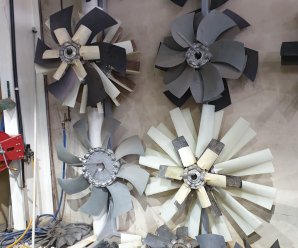
    A man and his fan housing.

    Matt explained a problem common to any axial fan: they hate back-pressure. When an axial fan blows air against a volute, which redirects the air laterally, the back-pressure acts like an air break. It pushes back against the fan, flexing the blades, reducing output volume and reducing efficiency.

    In an effort to relieve some of this pressure, Interlink cut a hole in the volute (called an “Unloader”). Venting reduced the pressure and increased efficiency significantly. It did something else, too, but we’ll get to that later.

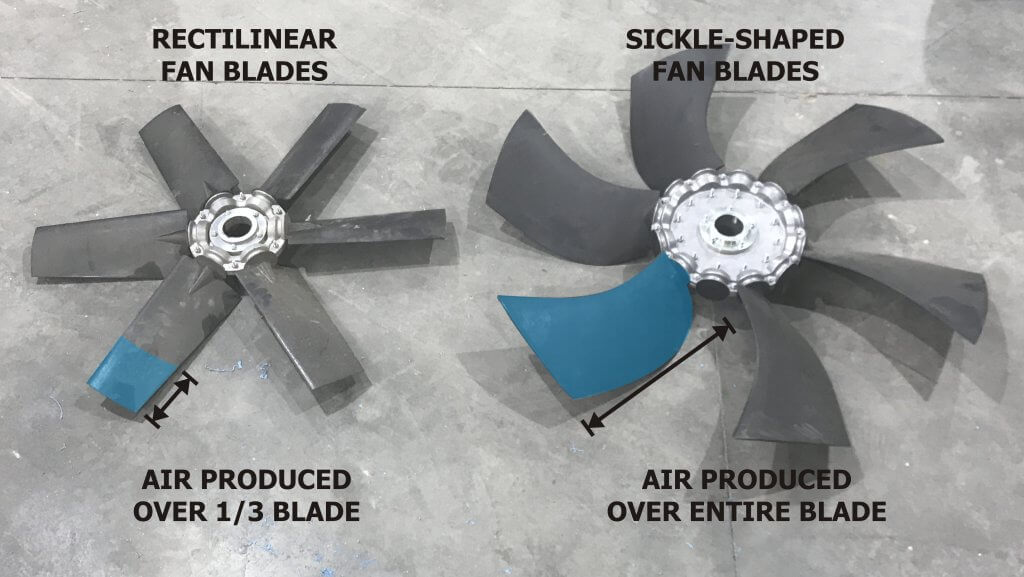
    This success led them to reconsider fan blade design. Classic, rectilinear fan blades are inefficient. They only produce air over the last 1/3 of their length. Using computational fluid dynamics, they modelled an efficient sickle-shape that creates pressure over the entire length. This means it can produce as much volume as a rectilinear blade, but with fewer revolutions.

    The difference between rectilinear and sickle-shaped fan blades.

    When the new blades were combined with the Unloader, they were able to move the fan closer to the volute and make the cowl longer. A less-exposed fan is not only safer, but its proximity to the volute increased efficiency.

    The result was a 2.5x increase in pressure and a concomitant 30% savings in horsepower. In other words, while similarly-sized sprayers were using 25 L (6.5 US gal.) of fuel per hour, they created the same air volume and speed using 17 L (4.5 US gal.) fuel per hour.

    But why stop there?

    Nut orchards in Australia and the US can grow up to 21 meters (~70 feet). A low-profile axial sprayer must produce a great deal of air volume to both penetrate the canopy and reach the top. Increasing fan diameter can help, but perhaps two fans are better? Air-O-Fan has their twin-fan system, where two shaft-driven fans with reversed blade pitches produce high-volume turbulent air. Interlock decided to try it.

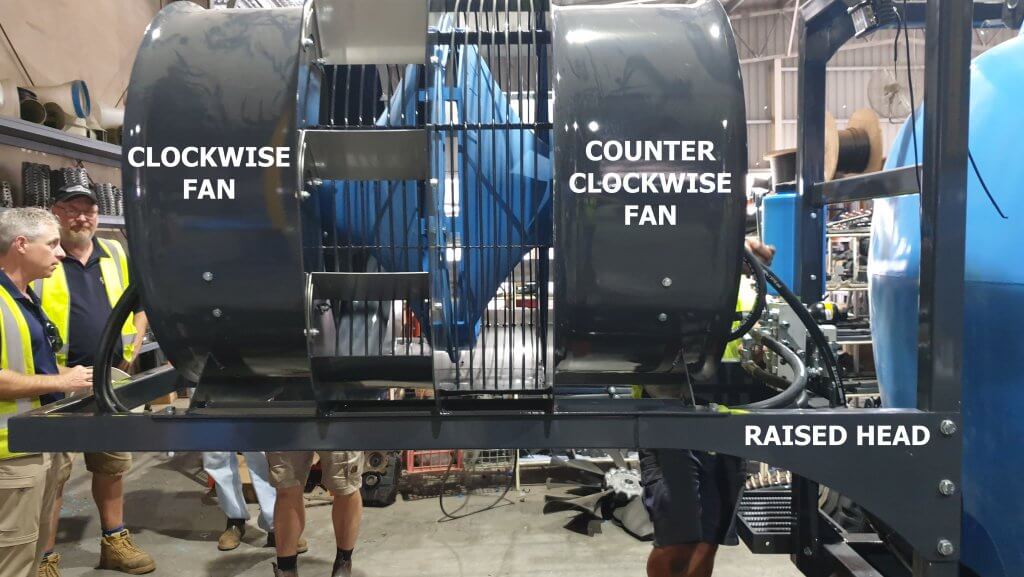
    Hydraulics permit the twin-fan head to be raised off the ground.

    When two hydraulically driven fans were placed back-to-back (spinning counter to one another) the Unloaders did something Unexpected. Normally, an axial fan blowing against a volute creates deflection, causing higher speeds on the downward side of the fan. Most sprayers use vanes to correct this, but they cause back-pressure. Serendipitously, when placed back-to-back, the pressure vented through the Unloaders was reclaimed on the upward side of each fan, equalizing airspeed across the outlet.

    The air vented through the Uploader evened-out the airspeed.
    Computational fluid dynamics demonstrate even air-speed and volume on both sides of the sprayer.

    And there’s still more. Since this counter-rotation twin fan design is hydraulically driven, it is not restricted by a shaft. This allows the head to be lifted off the ground. Quite often in large orchards, air and nozzles are aimed too low, wasting spray below the canopy. Lifting the fan and nozzle banks brings everything closer to the top of the canopy; a notoriously difficult target to reach. It also reduces the level of dust and detritus stirred up from the canopy floor. Operators reported that the elevated fan head helped keep fan intakes and radiators (required on Australian airblast sprayers) clear of debris.

    This low-profile axial airblast fan is a refreshing new approach to a design that has seen only marginal improvement over the last 20 years. Given the pace of innovation in Matt’s factory, I’m sure the next set of improvements will be in place by the time this article is published.

  • Rainfastness of Insecticides and Fungicides on Fruit

    Rainfastness of Insecticides and Fungicides on Fruit

    This article was co-authored by Kristy Grigg-McGuffin, OMAFA Horticulture IPM Specialist

    In view of the frequent heavy rains in many regions this season, understanding rainfastness, or the ability of a pesticide to withstand rainfall, is important to ensure proper efficacy. All pesticides require a certain amount of drying time between application and a rain event. Typically, residue loss by wash-off is greatest when rain occurs within 24 hours of spraying. After this point, the rainfastness of a product will depend on formulation, adjuvants and length of time since application.

    Rainfastness of Insecticides

    John Wise, Michigan State University has studied rainfastness of common tree fruit insecticide groups and his findings are summarized below. For the complete article, refer here. Note that some products listed in this article may not be registered for use in Canada. Check with your local supplier or in Ontario, refer to OMAFA Publication 360 for a complete list of registered products.

    According to Wise, the impact of rain on an insecticide’s performance can be influenced by the following:

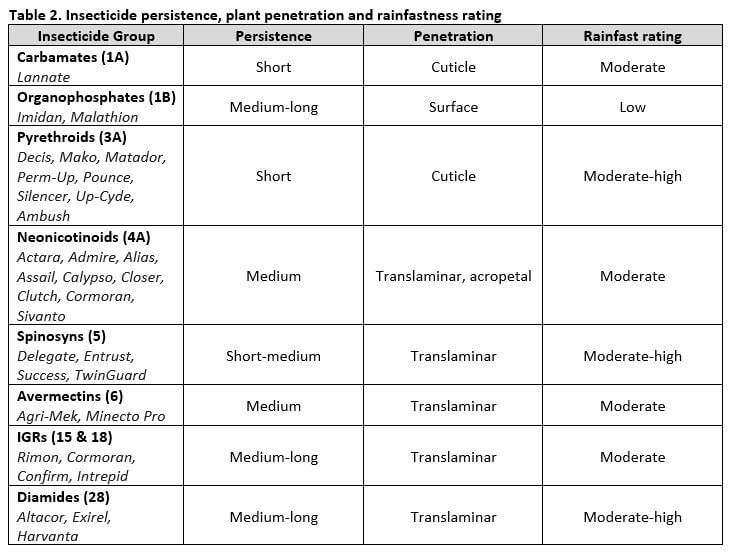
    1- Penetration

    Penetration into plant tissue is generally expected to enhance rainfastness.

    • Organophosphates have limited penetrative
      potential, and thus considered primarily surface materials.
    • Carbamates and pyrethroids penetrate the cuticle,
      providing some resistance to wash-off.
    • Spinosyns, diamides, avermectins and some insect
      growth regulators (IGR) readily penetrate the cuticle and move translaminar (top
      to bottom) in the leaf tissue.
    • Neonicotinoids are considered systemic or
      locally systemic, moving translaminar as
      well as through the vascular system to the growing tips of leaves (acropetal
      movement).
    • For products that are systemic or translaminar,
      portions of the active ingredient move into and within the plant tissue, but
      there is always a portion remaining on the surface or bound to the waxy cuticle
      that is susceptible to wash-off.

    2- Environmental persistence and inherent toxicity

    Environmental persistence and inherent toxicity to the target pest can compensate for wash-off and delay the need for immediate re-application.

    • Organophosphates are highly susceptible to
      wash-off, but are highly toxic to most target pests, which means re-application
      can be delayed.
    • Carbamates and IGRs are moderately susceptible
      to wash-off, and vary widely in toxicity to target pests.
    • Neonicotinoids are moderately susceptible to
      wash-off, with residues that have moved systemically into tissue being highly
      rainfast, and surface residues less so.
    • Spinosyns, diamides, avermectins and pyrethroids
      are moderate to highly rainfast.

    3- Drying time

    Drying time can significantly influence rainfastness, especially when plant penetration is important. For instance, while 2 to 6 hours is sufficient drying time for many insecticides, neonicotinoids require up to 24 hours for optimal penetration prior to a rain event.

    4- Adjuvants

    Spray adjuvants that aid in the retention, penetration or spread will enhance the performance of an insecticide.

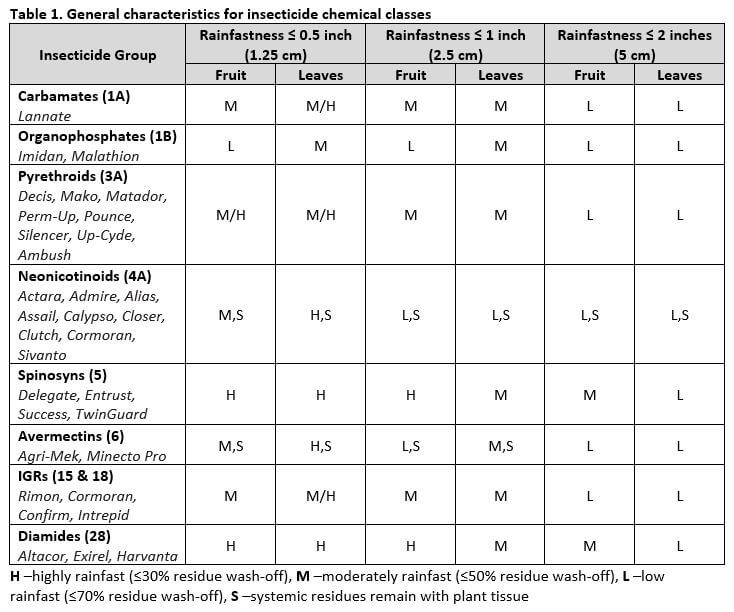
    The following tables can serve as a guide for general rainfastness to compliment a comprehensive pest management decision-making process. They are adapted from “Rainfast characteristics of insecticides on fruit” by John Wise, Michigan State University Extension.

    Based on simulated rainfall studies to combine rainfastness with residual performance after field-aging of various insecticides, including carbamates (Lannate), organophosphates (Imidan, Malathion), pyrethroids (Capture), neonicotinoids (Assail, Actara, Admire), IGRs (Rimon, Intrepid), spinosyns (Delegate) and diamides (Altacor), Wise recommends the following re-application decisions for apples. Additional work was done on grapes and blueberries; see Wise’s article for this information. Among the crops, variation in rainfastness of a specific insecticide occurs since the fruit and leaves of each crop have unique attributes that influence the binding affinity and penetrative potential.

    • ½ inch (1.25
      cm) rainfall:
      All products with 1-day old residues could withstand ½ inch
      of rain. However, if the residues have aged 7 days, immediate re-application
      would be needed for all products but Assail, Rimon, Delegate or Altacor on
      apples.
    • 1-inch (2.5
      cm) rainfall:
      In general, most products would need re-application following
      a 1-inch rainfall with 7-day old residues, whereas Delegate and Altacor could
      withstand this amount of rain on apples and would not need to be immediately
      re-applied. Some products such as Imidan on apples could withstand 1 inch of
      rain with 1-day old residues.
    • 2-inch (5
      cm) rainfall
      : For all products, 2 inches of rain will remove enough
      insecticide to make immediate re-application necessary.

    It is important to note, not all products registered for the selected pests were included in this study. Refer to Publication 360 for a complete list of management options.

    Rainfastness of Fungicides

    There is no comparable research on rainfastness of fungicides and few labels provide this kind of information. A general rule of thumb often used is that 1 inch (2.5 cm) of rain removes approximately 50% of protectant fungicide residue and over 2 inches (5 cm) of rain will remove most of the residue. However, many newer formulations or with the addition of spreader-stickers, some products may be more resistant to wash-off. Avoid putting on fungicides within several hours before a rainstorm as much can be lost to wash-off regardless of formulation. As well, there are exceptions to the general rule in regard to truly systemic fungicides such as Aliette and Phostrol.

    The effectiveness of sticker-spreaders with fungicides is variable and product/crop specific. Penetrating agents don’t help strobilurins; in fact, some fungicide/crop combinations have been associated with minor phytotoxicity due to excessive uptake. Captan, which is intended to stay on the surface, is notorious for causing injury when mixed with oils or some penetrating surfactants that cause them to penetrate the waxy cuticle.  Consult labels for minimum drying times for individual products and recommendations for using surfactants. 

    Annemiek Schilder, Michigan State University suggests the following to improve fungicide efficacy during wet weather:

    • During rainy periods, systemic fungicides tend
      to perform better than protectant (or contact) fungicides since they are less prone
      to wash-off.
    • Applying a higher labelled rate can extend the
      residual period.
    • Apply protectant fungicides such as captan
      (Supra Captan, Maestro), mancozeb (Manzate, Dithane, Penncozeb) and metiram
      (Polyram) during sunny, dry conditions to allow for quick drying on the leaves.
      These types of fungicides are better absorbed and become rainfast over several
      days after application.
    • Apply systemic fungicides such as sterol
      inhibitors (Nova, Fullback, Inspire Super), SDHI (Fontelis, Sercadis, Kenja, Aprovia
      Top, Luna Tranquility) and strobilurins (Flint, Sovran, Pristine) under humid,
      cloudy conditions. The leaf cuticle will be swollen, allowing quicker
      absorption. In dry, hot conditions, the cuticle can become flattened and less
      permeable, so product can breakdown in sunlight, heat or microbial activity or
      be washed off by rain.

    Click here to refer to the complete article.